

This document is compiled based on sensor device manuals, parameter specifications, publicly available humanoid robot industry data, and embodied intelligence sensing technology white papers. It is organized into four modules: industry background → industry development trends → detailed implementation solutions for 590C/540C by body part (installation location, pain points addressed, implementation benefits) → three-tier value summary (robot body + end customers + entire industry). All parameters are benchmarked against the original technical specifications of Senser's 540C and 590C from the Senther official website.
I. Industry Background: Humanoid Robots + Piezoelectric Vibration Sensing
1. Imperative Background of Humanoid Robot Industrialization
Global humanoid robots have entered a mass-production implementation cycle. Humanoid models such as Optimus, Atlas, and domestic platforms from UBTECH, Xiaomi, and Unitree are transitioning from laboratory prototypes to commercial deployment. Four major technologies have become mass-production bottlenecks: precision joint motion control, foot-sole gait stability, dexterous hand compliant grasping, and whole-machine fault self-diagnosis.
Current mainstream sensing configurations in robots: joints predominantly use strain-gauge torque sensors and MEMS capacitive accelerometer chips; foot soles and hands rely on piezoresistive/capacitive tactile sensors. However, all three device types have clear shortcomings:
1. MEMS capacitive chips: signal-to-noise ratio plummets at high frequencies (>5 kHz), with bandwidth generally 0.1%/°C) causes severe gait drift in high/low-temperature environments.
2. Strain-gauge torque sensors: can only measure static torque; dynamic impact and instantaneous slip vibration cannot be identified; response is in the millisecond range, falling short of the microsecond-level requirements for instantaneous robot collision protection.
3. Piezoresistive/capacitive tactile sensors: can only measure static pressure; object sliding, collision impact, and surface micro-vibration cannot be effectively captured, making fine grasping highly prone to slippage and workpiece damage.
Piezoelectric sensing, relying on the direct piezoelectric effect, offers microsecond-level dynamic response and bandwidth covering 0.5 Hz–28 kHz, making it inherently suited for dynamic vibration, impact, and slip signal acquisition—a necessary solution to compensate for existing sensing shortcomings. According to IDC 2026 data: the market for vibration/tactile sensors dedicated to humanoid robots is growing at 132% annually, with enormous import-substitution space for domestic piezoelectric chips. High-end piezoelectric accelerometer chips have long been monopolized by overseas brands, resulting in high procurement costs and unstable lead times.
2. Senser 590C/540C Product Technical Background (Core Parameters, Basis for the Solution)
(1) 540C: Single-axis piezoelectric vibration chip (Z-axis unidirectional measureme)
Frequency response: 0.5 Hz–28 kHz (±3 dB), 4 μg/√Hz @1 kHz ultra-low noise;
Range options: 540C-50 (±50 g, 40 mV/g high sensitivity), 540C-500 (±500 g, 4 mV/g large range);
Package: 10×10×5.5 mm SMT surface-mount, 3–5.5 V supply, power consumption
Features: unidirectional acquisition, lower cost, compact size, suitable for targeted vibration measurement in confined cavities.
(2) 590C: Three-axis piezoelectric vibration chip (X/Y/Z three-dimensional synchronous acquisition)
Frequency response: 1–15,000 Hz, 8 μg/√Hz @1 kHz, nonlinearity ≤±1%;
Range: ±500 g full scale, ultimate shock resistance 5000 g;
Package: 15.6×15.6×5.5 mm surface-mount, 3–5.5 V supply, single-axis power consumption
Features: three-dimensional omnidirectional vibration/shock synchronous sampling, suitable for multi-dimensional compound vibration at joints and whole-machine attitude-coupled vibration monitoring.
Selection logic: For directional single-point vibration, use the 540C single-axis; for multi-dimensional compound vibration/attitude coupling, use the 590C three-axis. Both are 100% domestically produced, with costs 35%–60% lower than imported piezoelectric chips of equivalent specifications—a core domestic solution for cost reduction + performance upgrade of humanoid robots.
II. Future Development Trends of Piezoelectric Vibration Sensing in Humanoid Robots
Trend 1: Multi-sensor fusion becomes standard (piezoelectric + capacitive + strain gauge)
Industry consensus: capacitive/piezoresistive sensors measure static pressure, piezoelectric chips measure dynamic vibration/impact/slip, and strain gauges measure steady-state torque. The fusion of these three sensing hardware types + edge algorithm preprocessing will be the standardized design for mass-production models over the next three years. Piezoelectric chips are no longer optional accessories but mandatory dynamic sensing devices for joints, foot soles, and dexterous hands.
Trend 2: Miniaturization and SMT integration of piezoelectric chips replacing external sensors
Traditional industrial piezoelectric sensors are bulky and screw-mounted, making them impossible to embed in the narrow joint cavities of robots. SMT surface-mount piezoelectric chips such as the 590C/540C can be directly mounted on PCBs or inside reducer housings, enabling embedded, imperceptible integration. After 2027, more than 90% of new models will adopt board-mounted piezoelectric vibration solutions.
Trend 3: Large-scale implementation of predictive maintenance (PHM) based on piezoelectric vibration data
Leveraging high-frequency piezoelectric vibration data, AI algorithms analyze characteristic spectra of motor bearing wear, gear tooth fracture, and reducer clearance increase to enable early fault warning for robots, replacing traditional scheduled teardown maintenance. Batch deployment of PHM vibration diagnostic systems in industrial and service humanoid robots will become an industry standard.
Trend 4: Comprehensive import substitution of domestic piezoelectric chips
Driven by overseas sensor tariffs and supply chain restrictions, robot OEMs are accelerating the shift to domestic components. Domestic piezoelectric chips such as the 540C/590C, which match international first-tier parameters, will gradually replace imported piezoelectric accelerometers from 2026 to 2028. The core drivers are the cost advantage and delivery reliability of domestic piezoelectric sensing.
Trend 5: Implementation of piezoelectric tactile + vibration integrated electronic skin
High-frequency piezoelectric arrays integrated into robot arm surfaces enable simultaneous collision warning, slip identification, and material vibration recognition—a core technical pathway for bionic skin, with piezoelectric chips as the underlying hardware foundation.
III. Detailed Part-by-Part Implementation Solutions for Senser 590C and 540C in Humanoid Robots
Overall Selection Principles
Unidirectional fixed-point impact/directional vibration → 540C (e.g., foot-sole vertical landing impact, motor stator axial vibration). 540C-50 high sensitivity for small-amplitude vibration; 540C-500 large range for collision and landing impact scenarios.
Multi-dimensional compound vibration, three-axis attitude-coupled vibration → 590C (hip/knee/shoulder/elbow joints, torso modules), with three-dimensional synchronous acquisition of X/Y/Z jitter data.
Installation specification: Adhesive bonding or rigid screw fixation to the rigid surface of the measured structure; avoid soft adhesive bonding that attenuates high-frequency signals (Senser official installation specification).
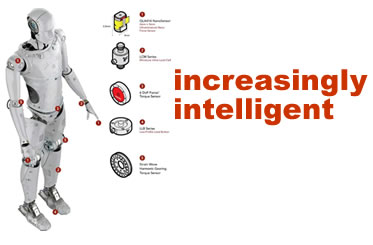
Humanoid robot sensor placement diagram
Point 1: Dual Foot Sole Modules (Primary: 540C; select points paired with 590C)
1. Installation Location
Hard support skeleton of each foot sole, ankle reducer output end face: 540C (540C-500 large range) arranged vertically (Z-axis) at the foot sole for landing; one 590C at the ankle three-axis torsional compound point. Per foot: 2× 540C + 1× 590C; both feet total: 4× 540C + 2× 590C.
2. Existing Industry Pain Points (Problems to Solve)
Traditional capacitive foot-sole sensors have insufficient bandwidth (
Landing impact cannot be quantified; long-term large impacts cause early bearing wear in ankle joint reducers, resulting in high whole-machine failure rates.
Foot-sole slip micro-vibration cannot be identified; gait cannot be adjusted instantaneously during walking slippage, leading to falls.
Capacitive sensors exceed temperature drift limits in low/high-temperature environments, causing gait deviation and lateral sway during level walking.
3. Implementation Benefits with 540C + 590C
540C (Z-axis) with 0.5–28 kHz full bandwidth accurately captures landing impact peaks; the main controller adjusts ankle servo output force in real time to buffer landing impact, improving stability on uneven surfaces by over 40%.
590C three-axis captures multi-directional torsional vibration (X/Y/Z) at the ankle, analyzes slip characteristic vibration spectra, and triggers gait correction at microsecond level—slip warning response speed is 100× that of the original capacitive solution.
Long-term vibration data monitors ankle bearing wear trends, enabling early fault warning and extending reducer life by 25%+.
Devices operate stably over a wide temperature range of −40°C to +125°C, with no significant gait drift across the full temperature range, greatly improving adaptability to high/low-temperature operating conditions.
Point 2: Major Joint Modules (Hip/Knee/Shoulder/Elbow; Primary: 590C Three-Axis Piezoelectric Chip.
1. Installation Location
Servo motor rear housing of each joint, inner side of harmonic reducer output flange. One 590C built into each major joint; a standard humanoid robot has 6 major joints (hip ×2, knee ×2, shoulder ×2, elbow ×2 optional), with 6× 590C as standard. One additional 540C (540C-50 high sensitivity) at the joint gear axial fixed point to capture gear-meshing directional vibration.
2. Existing Industry Pain Points
Strain-gauge torque sensors only measure static torque; high-frequency gear-meshing jitter and abnormal bearing vibration during high-speed motor operation cannot be detected; gear pitting and bearing seizure have no early warning, and sudden jamming causes whole-machine downtime.
Multi-dimensional compound jitter (X/Y/Z three-direction) at joints cannot be fully captured; servo closed-loop control lacks high-frequency feedback, resulting in large jitter and poor positioning accuracy during high-speed arm swinging and leg lifting.
Imported vibration sensors are expensive (single unit >300 RMB), keeping whole-machine BOM costs high and constraining mass production.
3. Implementation Benefits with 590C + 540C
590C three-axis full-frequency acquisition of multi-dimensional joint vibration; the servo system introduces high-frequency vibration closed-loop compensation, improving joint repeat positioning accuracy from ±0.3° to ±0.08° and significantly suppressing high-speed motion jitter.
540C high sensitivity captures gear-meshing abnormal spectra; PHM algorithms identify gear wear, oil deficiency, and tooth fracture hazards, providing fault warnings 300–500 operating hours in advance and avoiding sudden downtime.
Domestic chips replace imported devices, reducing single-joint sensing BOM cost by over 45%, meeting the cost-reduction requirements of whole-machine mass production.
Point 3: Dexterous Hand (Five Fingertips + Palm Cavity; Fingertips: 540C; Palm Base: 590C)
1. Installation Location
One 540C-50 (high sensitivity 40 mV/g) surface-mounted in the inner cavity of each of the 5 fingertips; one 590C at the palm drive motor base. Per dexterous hand: 5× 540C + 1× 590C; both hands total: 10× 540C + 2× 590C.
2. Existing Industry Pain Points
Fingertips only have capacitive static pressure sensing; when grasping smooth workpieces (glass cups, metal shafts) and slippage occurs, there is no dynamic vibration signal to enable instantaneous grip force tightening, causing workpieces to slip and fall.
Fingertip collision with hard objects provides no instantaneous impact feedback; excessive force crushes fragile items.
Miniature servo motors inside the palm cannot accommodate built-in monitoring sensors in the confined space; motor overheating and rotor eccentricity faults cannot be diagnosed online.
3. Implementation Benefits with 540C + 590C
540C captures fingertip slip micro-vibration (kHz level) at microsecond level; the main controller dynamically fine-tunes finger grip force within 10 ms, improving fine grasping yield by 35% and eliminating slippage and damage.
When impact exceeds the threshold, the piezoelectric signal instantly triggers emergency grip release protection, preventing fragile workpieces from being crushed.
590C monitors omnidirectional vibration of the palm drive motor, identifying rotor eccentricity and coil abnormal noise faults, enabling online fault self-diagnosis of the dexterous hand and reducing repair rates.
Point 4: Torso Thoracic Cavity (Servo Main Controller Power Supply, Cooling Fan, Torso Pitch Joint; Primary: 590C; Fan Fixed Point: 540C)
1. Installation Location
One 590C at the torso pitch reducer end face; one 540C-50 arranged axially at the built-in cooling fan. Whole torso: 1× 590C + 1× 540C.
2. Existing Industry Pain Points
Multi-axis coupled vibration from torso pitch motion cannot be captured in three dimensions, causing significant upper-body sway during standing.
Built-in cooling fan eccentricity, abnormal noise, and stall have no online monitoring; fan failure leads to main controller chip overheating and downtime.
3. Implementation Benefits
590C three-dimensional vibration data optimizes the torso attitude algorithm, reducing upper-body sway amplitude by 50%.
540C monitors fan vibration spectra, providing early warning of stall/eccentricity faults and ensuring whole-machine thermal stability.
IV. Three-Tier Value Summary (Robot Body Value + End Customer Value + Industry-Wide Value)
(1) Value to the Humanoid Robot Body
Motion performance upgrade: Piezoelectric high-frequency dynamic sensing fills the high-frequency blind spots of traditional sensing, achieving leapfrog improvements in gait stability, joint positioning accuracy, and dexterous hand fine manipulation capability, bringing robot dynamic bionic fidelity closer to human motion characteristics.
Reliability and lifespan improvement: Full-point vibration PHM fault warning enables early prediction of faults in core wear parts such as motors, reducers, and bearings, increasing whole-machine mean time between failures (MTBF) by 25%–30%.
Expanded environmental adaptability: 540C/590C operate stably over a wide temperature range (−40 to 125°C), enabling deployment in extreme scenarios such as high/low-temperature workshops, outdoors, and cold chain environments, breaking the temperature drift limitations of conventional capacitive sensors.
Whole-machine lightweight integration: SMT surface-mount chips with small footprint and embedded installation eliminate traditional external sensor mounting brackets and excess wiring, optimizing internal space layout and facilitating robot weight reduction and miniaturization.
(2) Value to Downstream End Customers (Robot OEMs, B-End Commercial Buyers)
Mass-production cost reduction: 590C/540C domestic substitution for imported piezoelectric/MEMS sensors reduces sensing module BOM cost by 35%–60%, optimizing ex-factory cost and enhancing product pricing competitiveness.
Product differentiation competitiveness: Robots equipped with piezoelectric omnidirectional dynamic sensing outperform competitors in industrial collaborative assembly, service housekeeping, and rehabilitation assistive scenarios, helping OEMs secure high-end commercial orders.
Reduced customer O&M costs: Predictive fault warning replaces scheduled teardown maintenance, reducing equipment maintenance costs for B-end customers (factories, commercial service providers) by 40%+ and significantly cutting downtime losses.
Expanded scenario deployment: Scenarios previously unaddressable—high/low temperatures, complex road conditions, precision assembly—become commercially viable, enabling customers to expand into more application tracks (automotive parts assembly, cold chain inspection, elderly care).
(3) Industrial Value to the Entire Humanoid Robot Industry
Accelerates domestic substitution of core sensors: With the mature domestic piezoelectric solutions of 540C/590C as benchmarks, breaks the monopoly of overseas brands in the high-end vibration accelerometer field, improves the security of the domestic humanoid robot component supply chain, and eliminates risks from overseas chip supply and tariff restrictions.
Promotes industry sensing standardization: Establishes a standardized piezoelectric placement solution of "540C single-axis fixed-point + 590C three-axis compound," providing a general selection specification for dynamic vibration sensing in the humanoid robot industry and shortening OEM new-product development cycles.
Drives bionic sensing technology iteration: Large-scale deployment of piezoelectric chips accelerates the industrialization of piezoelectric electronic skin and multi-modal fusion sensing, advancing humanoid robots from "can walk" to "has touch, can perceive" higher-order bionic evolution, and accelerating embodied intelligence commercialization.
Expands the cross-industry piezoelectric sensing ecosystem: Extending from industrial machinery to the hundred-billion-level new track of humanoid robots, driving upgrades across the entire domestic supply chain of piezoelectric ceramic materials, packaging processes, and edge vibration algorithms, and completing the domestic piezoelectric sensing industry ecosystem.
Supplementary Note (This solution is derived from AI-generated content and is intended solely for learning and technical exchange. For detailed application requirements, please contact Senther Technology's technical engineers for in-depth communication.)
