

I. Project Background and Pain Points
Sliding bearings are widely used in high-speed spindles, heavy machinery, metallurgical rolling mills, steam turbines, large motors, precision machine tools, and other equipment. They rely on lubricating oil films to achieve liquid lubrication, friction reduction, load carrying, and vibration damping.
Common pain points:
· Oil film too thin → direct metal contact, bearing shell burning, journal seizure, spindle jamming
· Oil film too thick → insufficient stiffness, excessive vibration, increased energy consumption, poor stability
· Traditional methods: offline sampling, manual monitoring of oil temperature/pressure, empirical judgment → delayed, unreliable, unable to provide early warning
· Lack of online, real-time, non-contact, oil- and contamination-resistant oil film thickness measurement means
Value of the Senther Technology eddy current solution: non-contact, immune to oil, water, and dust, high-frequency response, long-term stability, directly embedded in the bearing housing for 24-hour online monitoring.
II. Monitoring Principle (Eddy Current Oil Film Measurement)
Core principle: eddy current displacement sensor → measures the gap between journal and bearing shell → gap = oil film thickness (dynamic + static)
· High-frequency alternating magnetic field from the sensor probe → eddy currents generated on the metal journal surface → reaction changes coil impedance
· Output voltage has a high-precision linear relationship with the probe–journal distance
· Oil film lies between the journal and bearing shell: measured gap change = oil film thickness change
· Advantages: unaffected by lubricating oil, oil temperature, oil mist, or metal chips; non-contact, no wear
Applicable range: oil film thickness 5–500 μm (typically 20–200 μm), accuracy up to ±1 μm.
III. Recommended Products
1. D8051 / D8111 Precision Eddy Current Displacement Sensor (core)
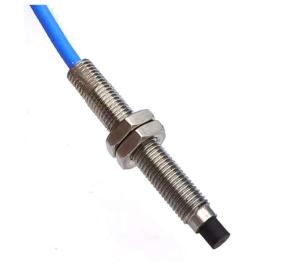
· Probe outer diameter: φ5.5 mm, short length, suitable for confined spaces in bearing housings
· Weight: 28 g (excluding cable), easy to install, vibration-resistant
· Frequency response: 0–10 kHz → captures high-speed dynamic oil film fluctuations
· Linear range: 0.5–2 mm (customizable according to bearing clearance)
· Output: -20 V standard voltage, compatible with industrial acquisition
· Cable: PFA oil- and high-temperature-resistant, can be routed directly inside machine tools/bearing housings
· Interchangeability: probe/cable/proximitor interchangeable, no on-site matching calibration required
2. Signal Proximitor (matching)
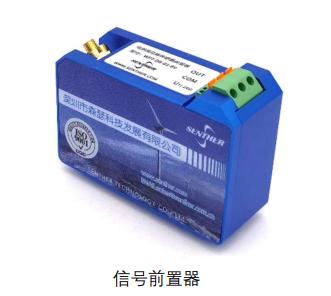
· Model: matching proximitor for D8051/D8111
· Functions: signal conditioning, filtering, linear compensation, temperature compensation
· Power supply: -24 Vdc
· Output: standard analog signal, direct connection to acquisition unit/PLC
3. Data Acquisition and System
· Multi-channel acquisition unit: IN-SDG 8-channel (synchronous acquisition of oil film + temperature + vibration)
· Host computer software: real-time display, curves, historical playback, reports, three-level warning
· Output interfaces: 4-20 mA / RS485 / Modbus / OPC UA, connectable to DCS/SCADA
IV. Measurement Point Layout and Installation Solution (Sliding Bearings)
1. Recommended installation positions
· Each sliding bearing: 2 probes (X, Y, 90° orthogonal)
· Installed in preset holes in the bearing housing/shell back, probe perpendicular to the journal surface
· Initial gap between probe and journal: 0.8–1.2 mm (at D8051 linear center)
· Cable fixed along bearing housing grooves, avoiding motion interference and high-temperature baking
2. Installation steps
· Machine M8 mounting hole in bearing housing (φ5.5 probe with M8 threaded sleeve)
· Screw in probe, adjust gap to approximately 1 mm, lock against loosening
· Route cable along fixed grooves, keep connectors away from high-temperature/oil impingement zones
· Install proximitor nearby (≤5 m) to reduce interference
· Power on system, perform static zeroing, range calibration, temperature compensation
· Start operation, monitor oil film thickness, journal center orbit, and vibration in real time
3. Measurement point schematic
Bearing housing (shell back)
↑Y (Probe 1)
X (Probe 2)——● Journal
V. Monitoring Parameters and Warning Strategy
1. Core monitoring parameters
· Real-time oil film thickness (μm): X-direction, Y-direction, average, minimum
· Oil film thickness fluctuation (peak-to-peak): dynamic stability
· Journal center orbit: ellipticity, whirl, eccentric wear trend
· Oil film stiffness/damping (indirect): combined with speed and load
· Oil temperature, bearing temperature, vibration (optional expansion)
2. Warning thresholds (field-adjustable)
· Normal: 40–150 μm (depending on bearing design)
· Level 1 warning (yellow): or >180 μm
· Level 2 warning (orange): or >220 μm
· Level 3 shutdown (red): (critical dry friction)
3. Output and linkage
· Pop-up + audible/visual alarm + SMS/WeChat push
· Local data storage ≥1 year, traceable
· Can link to speed reduction, load shedding, shutdown protection
VI. System Architecture (Full-Chain Closed Loop)
Sensor probe → Signal proximitor → Multi-channel acquisition unit → Host computer/PLC → Cloud platform (optional)
· Front end: D8051 eddy current probe (measures gap = oil film)
· Conditioning: proximitor (filtering, compensation, linearization)
· Acquisition: IN-SDG synchronous acquisition of oil film, temperature, vibration
· Analysis: real-time thickness, orbit, trend, fault diagnosis
· Application: warning, protection, maintenance decisions, life assessment
VII. Solution Advantages (Senther Technology vs. Traditional)
1. Truly online, truly real-time: 24-hour uninterrupted, millisecond response
2. Strong environmental adaptability: immune to oil, water, dust, high temperature
3. Non-contact, no wear: probe does not touch journal, long life, maintenance-free
4. Compact and flexible installation: φ5.5 mm probe fits confined bearing housings
5. Long-term stable and reliable: military-grade stability, low drift, strong anti-interference
6. Controllable cost: domestic self-developed, high cost-performance, short delivery, fast after-sales
VIII. Typical Application Scenarios
· Precision machine tool spindle sliding bearings
· Metallurgical rolling mill housing sliding bearings
· Steam turbine/generator radial bearings
· High-speed gearbox sliding bearings
· Heavy crusher, ball mill sliding bearings
IX. Implementation Cycle and Services
· Solution design: 3 working days
· Sensor customization/stocking: 5–7 days
· On-site installation and commissioning: 1–2 days/unit
· After-sales: 1-year warranty + lifetime technical support + remote diagnosis
X. Summary
The eddy current oil film monitoring solution, with D8051/D8111 as the core, achieves high-precision, non-contact, online real-time monitoring of sliding bearing oil film thickness, shifting from "post-failure maintenance" to "predictive maintenance," thoroughly eliminating bearing shell burning, journal seizure, and shutdown accidents, and ensuring safe, stable, and efficient equipment operation.
