

In large rotating machinery (such as steam turbines, hydro turbines, and compressors), the health of journal bearings (bearing shells) is directly related to the safe and stable operation of the entire unit. Bearing shell displacement is a key parameter for evaluating operating condition, oil film thickness, load status, and fault diagnosis. This paper presents a complete solution for static displacement and dynamic vibration monitoring of journal bearing shells using SENTHER D8111 series precision eddy current displacement sensors, covering operating principles, application advantages, system configuration, and implementation essentials.
I. Application Background and Challenges
Journal bearings separate the rotating journal from the stationary bearing shell via an oil film, providing efficient support. Bearing shell displacement (including static position and dynamic vibration) directly reflects:
Oil film thickness and pressure: Insufficient oil film thickness may cause metal-to-metal contact, leading to wear or even "bearing burnout" accidents.
Bearing load: Load variations under different operating conditions cause positional shifts of the bearing shell.
Assembly condition: Whether preload and clearance of the bearing shell are appropriate.
Dynamic stability: Presence of oil film whirl, oscillation, or other instability phenomena.
Conventional monitoring methods cannot achieve non-contact, high-precision, real-time measurement of bearing shell displacement. Eddy current displacement sensors, with their unique advantages, have become the ideal choice for this application.
II. Core Advantages of the SENTHER D8111 Sensor Solution
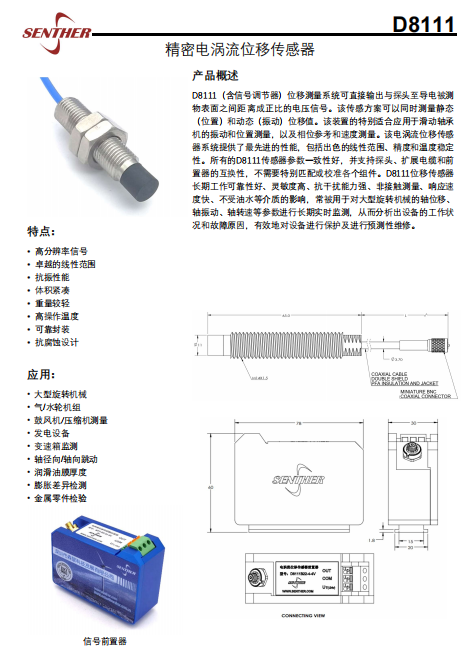
According to the technical documentation, the D8111 displacement measurement system provides superior performance for bearing shell monitoring:
Non-contact measurement, immune to oil media: The probe does not contact the measured bearing shell surface, completely eliminating mechanical loading effects. It can penetrate oil film and other media to directly measure metal bearing shell displacement, making it highly suitable for operation within lubrication systems.
High resolution and excellent linearity: Sensitivity up to 4 V/mm ±5%, with nonlinearity of only 1% FSO, enabling precise capture of micron-level displacement changes and providing reliable data for oil film thickness analysis and micro-vibration detection.
Superior dynamic response: Frequency response range of 0–10,000 Hz (-3dB), capable of measuring both static shaft position settlement and high-frequency bearing shell vibration, supporting analysis of mechanical dynamic characteristics.
Excellent environmental adaptability:
Wide temperature operation: Probe operating temperature range of -55°C to +150°C, fully accommodating the high-temperature environment inside bearing housings.
Rugged and durable: Probe housed in 316L stainless steel with IP67 protection rating, 12 MPa pressure resistance, corrosion-resistant, oil-proof, and waterproof, ensuring long-term reliability.
Strong interference immunity: Output signal has high noise immunity, suitable for complex industrial electromagnetic environments.
Component interchangeability and installation convenience: Probes, extension cables, and signal conditioners of the D8111 system offer excellent parameter consistency and interchangeability, requiring no individual calibration, significantly reducing maintenance costs and spare parts inventory pressure. The standard M14 mounting nut (PM0645) enables simple and quick installation.
III. Bearing Shell Displacement Monitoring System Configuration and Implementation
1. Measurement Point Layout
Mounting holes are typically machined on the back or side of the bearing shell to be monitored, with the sensor probe aligned perpendicular to the bearing shell back surface. At least one probe should be installed per bearing shell requiring monitoring. For critical bearings, probes are often installed in pairs (e.g., vertical and horizontal directions) to monitor the displacement vector under different loads.
2. System Composition (Based on "Measurement System Configuration Items" in the Documentation)
Sensing head: D8111 series probe, mounted directly on the bearing housing near the bearing shell.
Signal conditioner: D8111 signal conditioner, converting the probe signal to a standard voltage signal (-20V output). According to the selection guide, code B22 indicates a split-type signal conditioner with negative voltage (-24 Vdc) power supply and maximum output of -20V.
Signal acquisition unit: Optional IN-SDG 8-channel signal acquisition unit as mentioned in the documentation, for synchronized multi-point data acquisition.
Analysis and diagnostic platform: Connected to an industrial computer, working with the IN-91 portable signal analyzer or host software for real-time data display, recording, analysis, and early warning.
3. Measurement Parameters and Diagnostic Applications
Static displacement monitoring:
Oil film thickness estimation: By monitoring static position changes of the bearing shell relative to the housing, combined with journal position, average oil film thickness can be indirectly assessed.
Load monitoring: Observing bearing shell displacement trends during unit startup/shutdown or load changes to determine whether load distribution is uniform.
Thermal expansion differential: Monitoring expansion differences between bearing shell and bearing housing caused by temperature changes.
Dynamic vibration monitoring:
Bearing shell vibration: Direct measurement of vibration acceleration, velocity, or displacement of the bearing shell itself to assess stability.
Oil film whirl/oscillation: Analyzing vibration spectra to identify characteristic frequencies related to oil film dynamics and prevent instability faults.
IV. Selection Guide
For a typical application, a complete sensor selection code might be: D8111-B22-4-5-K3
D8111: Product model.
B22: Includes split-type signal conditioner, -24 Vdc power supply.
4: Measurement range of 4 mm (dynamic range 0.5–4.5 mm), meeting most bearing shell displacement monitoring requirements.
5: Cable length of 5 meters, accommodating on-site wiring requirements.
K3: Cable with metal armor, armor length of 3 meters. The armored section effectively protects the cable from damage in harsh mechanical environments, particularly suitable for routing inside equipment.
V. Conclusion
The SENTHER D8111 precision eddy current displacement sensor system, with its high precision, high reliability, non-contact measurement, and strong environmental adaptability, provides a complete and efficient solution for journal bearing shell displacement monitoring. Implementation of this solution enables "predictive maintenance" of bearing operating conditions, timely detection of hidden issues, prevention of catastrophic accidents, and effective assurance of long-term safe and stable operation of large rotating machinery—serving as a key technical means for intelligent equipment operation and maintenance.
