

Precision Measurement Requirements in the Industry 4.0 Era
With the rapid development of smart manufacturing and the Industrial Internet of Things (IIoT), high-precision, high-reliability displacement measurement technology has become a core element of modern industrial equipment monitoring and predictive maintenance. As a key component in this field, integrated precision displacement sensors are reshaping the standards for industrial equipment condition monitoring, thanks to their advantages such as non-contact measurement, wide range, and high stability. This article provides an in-depth analysis of the technical features and innovative industrial applications of the D8251A wide-range eddy current displacement sensor, offering engineering professionals a reference for selection and application.
I. Technical Breakthroughs and Core Advantages of the D8251A Sensor
1.1 Revolutionary Changes Brought by Integrated Design
The D8251A series adopts an integrated design with a built-in signal conditioner, fundamentally changing the complex architecture of traditional eddy current sensors that require an external signal conditioner. This innovative design delivers three significant advantages:
Simplified system: Direct standard voltage output (0.75 V/mm ± 5%), eliminating intermediate conversion stages.
Easy installation: Total weight of only 300 g (excluding cable), saving 80% of installation space.
High interchangeability: All components (probe, cable) are fully interchangeable without recalibration.
1.2 Breakthrough Wide-Range Performance
The sensor achieves an ultra-wide dynamic range of 12 mm (1.5–13.5 mm) while maintaining 1.5% FSO non-linearity, a leading specification among comparable products. Its technical breakthroughs include:
Multiple range coverage: Different ranges are identified by model suffix (e.g., A13 denotes a 12 mm range).
Temperature stability: Temperature coefficient ≤0.05%/℃, ensuring measurement accuracy in extreme environments from -55℃ to +120℃.
Full-band response: 10 kHz (-3 dB) wideband characteristics, capturing both static displacement and dynamic vibration signals simultaneously.
1.3 Industrial-Grade Reliable Design
The D8251A combines a 304 stainless steel housing with PFA cable for multiple layers of protection:
Mechanical protection: Withstands 20 N·m installation torque, IP67 protection rating.
Chemical protection: Resistant to oil contamination and acid/alkali corrosion, suitable for direct contact with cooling media.
Electrical protection: Insulation resistance >100 MΩ, effectively suppressing electromagnetic interference in industrial environments.
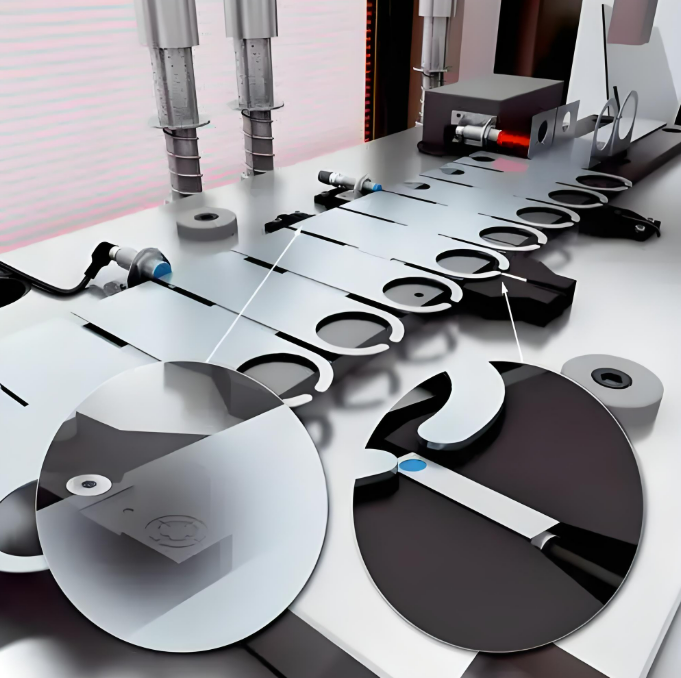
II. Analysis of Typical Industry Application Scenarios
2.1 Critical Monitoring in the Energy and Power Sector
In large generator sets, the D8251A system can build a full-dimensional monitoring network:
Turbine shaft system monitoring: Simultaneous measurement of axial displacement (0–12 mm) and radial vibration (0–1000 Hz).
Blade health diagnostics: Capturing blade passing frequency through 10 kHz high-frequency response.
Thermal expansion monitoring: Temperature stability of ≤0.05%/℃ ensures long-term monitoring accuracy.
A case study of a 1000 MW supercritical unit showed that, after adopting an 8-channel configuration (IN-SDG collector), a bearing shell loosening fault on bearing #5 was warned 72 hours in advance, avoiding direct economic losses exceeding 2 million yuan.
2.2 Predictive Maintenance in the Process Industry
In the petrochemical field, the sensor addresses the pain points of traditional contact measurement:
Compressor monitoring: Withstands 12 MPa pressure, installed directly on the high-pressure cylinder.
Pump fleet health management: Metal-armored cable (K3 option) resists chemical corrosion.
Coupling alignment: 0.1 μm resolution enables precise alignment adjustment.
Application data from a refinery fluid catalytic cracking unit showed that, after adopting the D8251A, the unplanned downtime rate decreased by 63% and maintenance costs dropped by 41%.
2.3 Quality Control in High-End Equipment Manufacturing
In precision manufacturing, the sensor delivers unique value:
Gearbox testing: Simultaneous acquisition of gear meshing vibration (high frequency) and shaft displacement (static).
Metal part inspection: Non-contact measurement avoids surface damage to workpieces.
Assembly verification: 0.75 V/mm sensitivity enables micron-level assembly precision control.
After adoption by an automotive gearbox manufacturer, the product defect rate dropped from 3.2% to 0.7%, with annual quality cost savings of 5.8 million yuan.
III. System Integration and Innovative Application Solutions
3.1 Intelligent Monitoring System Architecture
A typical four-layer architecture enables end-to-end monitoring:
[Sensor head] ---> [24 VDC power supply] ---> [IN-SDG collector] ---> [Analysis software]
An optional IN-91 portable analyzer enables on-site diagnostics. The system supports:
Multi-parameter fusion: Combined analysis of displacement + vibration + rotational speed.
Phase reference: Order analysis synchronized with keyphasor signals.
Trend prediction: Remaining life estimation based on long-term displacement data.
3.2 Key Selection Considerations
Model code selection:
D8251 A 1 3 - 12 - 5 K3
│ │ │ │ │ │ └─3 m armored cable
│ │ │ │ │ └─5 m cable
│ │ │ │ └─12 mm range
│ │ │ └─Positive voltage output
│ │ └─Positive pressure supply
│ └─Integrated conditioner
└─Base model
Key selection factors:
Range selection: Actual displacement is recommended to fall within 30%–70% of the range.
Cable configuration: Choose metal-armored cable (K option) for high-temperature environments.
Acquisition setup: High-frequency vibration requires a sampling rate above 10 kHz.
3.3 Installation Optimization Recommendations
Axial measurement: Angle between the probe centerline and the shaft centerline.
Surface treatment: 40CrMo material requires Ra
Environmental adaptation: Mu-metal shielding is recommended for strong magnetic field environments.
IV. Technology Trends and Market Outlook
With the deepening development of the Industrial Internet of Things, integrated precision displacement sensors are evolving in three major directions:
Intelligent upgrade: Built-in edge computing capability for direct output of characteristic parameters.
Wireless integration: Support for 5G/WiFi wireless transmission protocols.
Multi-physical quantity fusion: Integration of temperature, acceleration, and other multi-dimensional sensing.
Market research data shows that the global industrial displacement sensor market will grow at a CAGR of 7.2% from 2023 to 2028, with the eddy current technology share expected to rise to 38%. High-performance products such as the D8251A will become the preferred solution for intelligent transformation in the process industry.
Through its integrated design, the D8251A wide-range eddy current displacement sensor has democratized precision measurement technology. The perfect combination of a 12 mm range and 10 kHz bandwidth sets a new benchmark for industrial equipment condition monitoring. Driven by the "Made in China 2025" strategy, such high-performance sensors will become indispensable "nerve endings" of smart factories, providing a more precise data foundation for equipment health management. Users are advised to fully consider actual operating conditions during selection and to build optimal monitoring solutions with technical support from professional manufacturers.
