

I. Industry Background
Assessing the health, safety, and comfort of building structures directly affects a building's service life and the user experience. The assessment process focuses on issues such as material aging, structural damage, cracks, and deformation, enabling the timely identification of safety risks and hidden hazards along urban lifelines. At the same time, identifying acceleration changes and vibration frequencies under various loads provides a scientific basis for structural reinforcement and repair. But how can real-time, accurate identification and judgment be achieved? The core purpose of vibration monitoring for buildings is to ensure structural safety and occupant comfort.
By monitoring building vibrations in real time, structural problems can be detected promptly, measures can be taken to prevent potential accidents, and the stability and safety of the building can be ensured.

II. Significance of Monitoring
1. Early warning and structural safety assessment: By monitoring building acceleration, issues such as cracks, deformation, or material fatigue can be detected in a timely manner, providing a scientific basis for preventing potential accidents. This monitoring method captures subtle dynamic changes in buildings under various external forces in real time, effectively enabling early warning and assessment of structural safety conditions.
2. Design optimization and comfort improvement: Understanding a building's vibration characteristics under various conditions allows for optimized structural design, reduced unnecessary vibration, and improved comfort in living or working environments. Building vibrations directly affect occupant comfort. Acceleration monitoring provides a better understanding of a building's vibration characteristics under various conditions, thereby enabling optimized structural design. By reducing unnecessary vibration, the comfort of living or working environments can be improved, allowing people to enjoy a more comfortable and pleasant experience when using the building.
3. Safeguarding critical infrastructure: Building vibration monitoring is widely used in high-rise buildings, long-span bridges, subway tunnels, and other critical infrastructure to ensure their normal operation and safety. By continuously monitoring changes in building acceleration, the stability and safety of structures under different operating conditions can be accurately assessed. This monitoring process provides a scientific basis for preventing potential accidents, enabling management and maintenance units to take timely measures to avoid possible hazards.
4. Environmental impact assessment: Investigating environmental factors surrounding a building, assessing their impact on building vibration, and predicting possible future effects on the building.
The implementation of vibration monitoring relies on professional sensors and data analysis techniques. Sensors collect building vibration data in real time, and data analysis techniques process this data; once an anomaly is detected, the system immediately issues an early warning.
III. Role of Monitoring
Vibration sensors in buildings are primarily used to monitor structural vibration, helping architects and engineers understand structural conditions and ensure stability under various vibration scenarios.
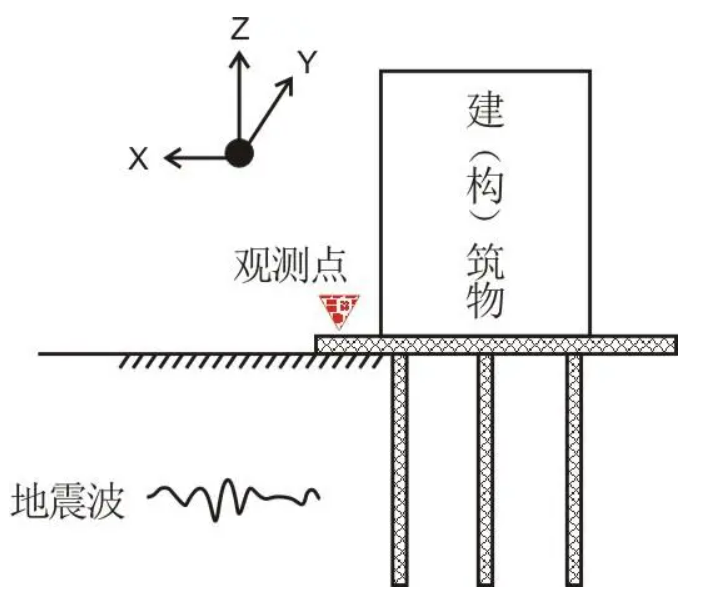
Vibration sensors can be installed at various locations in a building, such as walls, floors, and beams. Once the building vibrates, the sensors transmit data to the monitoring system for real-time monitoring. This helps identify building problems such as cracks and deformation in a timely manner, allowing necessary maintenance measures to be taken to ensure the safety and stability of the building.
Vibration sensors measure vibration parameters such as vibration velocity, frequency, and acceleration, converting these parameters into electrical signals for recording and analysis. If abnormal vibration is detected, the sensors issue timely alarms, alerting relevant personnel to conduct inspection and repair. This is of great significance for preventing structural damage and ensuring occupant safety.
Specific application examples include:
Equipment monitoring and maintenance: In large building projects such as bridges and high-rises, vibration sensors are used to monitor the operating status of large equipment, ensuring equipment reliability and efficiency. Real-time data analysis enables prediction of equipment failures and reduces downtime.
Earthquake early warning: Vibration sensors can sense vibrations from natural disasters such as earthquakes, promptly shutting off gas or power to prevent secondary disasters.
Structural health monitoring: Long-term monitoring of building vibrations assesses building health and enables timely identification and resolution of potential problems.
IV. Benefits of Monitoring
Assessing overall building health: Vibration monitoring enables rapid and accurate assessment of overall building health, providing reliable data support regarding the building's actual condition.
Early detection of potential accident signs: Vibration monitoring can detect early signs of potential accidents in buildings, effectively protecting life and property.
Providing reference for structural design and improvement: By analyzing vibration data, a building's natural frequencies and mode shapes can be calculated, providing reference for structural design and improvement.
Diagnosing and assessing building defects: Vibration monitoring helps identify abnormal structural vibration. By analyzing vibration data, the type and severity of structural defects can be determined, providing a basis for further repair and reinforcement work.
Assessing structural health and risk: Long-term vibration monitoring and data analysis enable quantitative assessment of structural health, evaluation of seismic performance and risk levels, and provide a scientific basis for building management and maintenance.
V. Monitoring Parameters
Displacement monitoring: Sensors installed at critical locations in a building record displacement data in real time to assess stability. L3001-50.8 LVDT Displacement Sensor, Senther Technology (senther.com)
Stress monitoring: Real-time monitoring of stress changes in a building during load-bearing processes, flagging potential safety hazards.
Vibration monitoring: Assessing a building's response under dynamic loads, providing parameters such as vibration frequency and amplitude to evaluate seismic performance. In building vibration monitoring, the 394A triaxial micro-vibration sensor and the 374A uniaxial micro-vibration sensor can monitor building vibrations in real time, providing accurate data support for smart city informatization. Combined with data acquisition systems and analysis software, they enable health assessment and early warning of building structures, improving building safety and reliability.
Environmental parameter monitoring: Monitoring natural factors such as temperature, humidity, and wind speed, predicting their potential impact on the building, and taking corresponding protective measures.
Through these means, building vibration monitoring not only ensures building safety but also improves building service life and occupant comfort.
