

I. Vibration and Noise: The "Disruptors" of Acoustic Stealth
Any operating mechanical equipment—from submarines and naval vessels to ground combat vehicles and aircraft—generates intense structural vibration from internal components such as engines, gearboxes, pumps, and propellers. These vibrations are transmitted through the structure to the hull and radiate noise into the surrounding medium (e.g., water or air). For underwater equipment, noise is highly susceptible to detection by sonar systems; for ground and airborne equipment, specific vibration frequencies and noise signatures are likewise targets for enemy reconnaissance assets. Therefore, effectively suppressing vibration sources and blocking vibration transmission paths directly determines the acoustic stealth performance of equipment and is of paramount importance for enhancing battlefield concealment and surprise.
II. Precise Sensing as the Prerequisite for Noise Reduction: Core Advantages of the 573A Sensor
Achieving vibration and noise reduction cannot be done "blindly"—it must rely on precise measurement data. With its outstanding technical characteristics, the 573A accelerometer provides an ideal solution for vibration diagnostics of acoustic stealth equipment.
High Resolution and Low Noise: The "high resolution" and "low noise" emphasized in the documentation are the core advantages of the 573A. When attempting to capture weak vibration signals to identify incipient faults or measure extremely low noise levels, the sensor's own background noise must be sufficiently low. The low-noise design of the 573A ensures that it can clearly and accurately extract the true vibration signal of the measured object rather than being overwhelmed by its own electronic noise—critical for identifying subtle vibration modes that indicate potential noise problems.
Wide Frequency Band Response: The vibration and radiated noise generated by equipment typically contain rich spectral information from low to high frequencies. The "wide frequency band response" of the 573A enables comprehensive capture of vibration data across this broad frequency range—whether the low-frequency rumble of an engine or the high-frequency whine of gear meshing—providing a complete data foundation for subsequent spectral analysis and noise source localization.
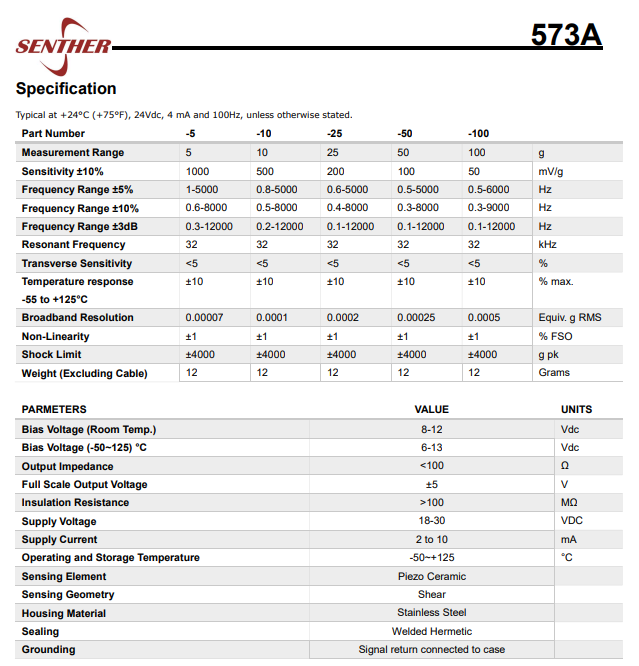
Rugged and Reliable, Adaptable to Harsh Environments: Equipment designed for enhanced acoustic stealth often operates in extreme environments. The "metal laser-welded sealing" process of the 573A ensures excellent hermeticity, resisting moisture, salt fog, and other corrosive environments; the "wide operating temperature range" ensures stable performance across temperature variations from frigid polar regions to hot deserts. This reliability is a fundamental requirement for military applications.
Flexible Mounting and Integration: Support for "adhesive or stud mounting" and optional insulated mounting bases allows the 573A to be flexibly deployed on various complex structures of equipment and effectively prevents ground loop interference, ensuring signal purity. Its miniature connectors and compact design also facilitate integration in space-constrained locations.
III. Application Scenarios: From Test Verification to Condition Monitoring
Based on the above advantages, the 573A accelerometer plays a key role throughout the entire lifecycle of equipment vibration and noise reduction:
Modal Analysis and Structural Optimization: During the R&D phase of new equipment, modal analysis conducted by deploying 573A sensor arrays on critical structural components enables precise acquisition of dynamic characteristics such as natural frequencies and mode shapes. Engineers can use this data to optimize structural design, avoid resonance, and reduce vibration and noise radiation at the source.
Performance Evaluation of Vibration Damping/Isolation Systems: The effectiveness of various vibration dampers and isolation mounts installed on equipment requires quantitative evaluation. Using the 573A to measure vibration levels upstream and downstream of the damping system allows precise calculation of vibration transmission loss, thereby enabling screening and optimization of damping solutions and directly enhancing acoustic stealth performance.
Condition Monitoring and Fault Diagnosis of Power Equipment: Long-term vibration monitoring of ship power compartments, vehicle drivetrains, and similar systems—using data acquired by the 573A—enables analysis of the health of rotating components and early identification of faults such as bearing wear and blade imbalance. Timely maintenance not only prevents catastrophic failure but also eliminates abnormal noise caused by component degradation, maintaining optimal acoustic stealth status of equipment.
Shock Testing and Durability Verification: The shock testing capability mentioned in the documentation can be used to verify structural integrity and functional normality of internal equipment after exposure to explosive shock waves or severe impacts, ensuring that acoustic stealth coatings or structures are not damaged under extreme shock.
Conclusion
In the field of modern equipment pursuing ultimate acoustic stealth performance, vibration and noise reduction is no longer merely a comfort requirement but a strategic necessity concerning survivability and effectiveness. The 573A series low-noise IEPE accelerometer from Sensor Technology provides engineers with a sharp eye for discerning the mysteries of vibration through its high resolution, low noise, wide frequency band, and superior environmental adaptability. It spans the entire process from initial design and performance verification to in-service monitoring and is an indispensable key tool for precisely locating noise sources, evaluating noise reduction effectiveness, and ultimately enhancing equipment acoustic stealth. Choosing the 573A means choosing a reliable "Silent Guardian" for your equipment—ensuring victory on the battlefield in silence.
