

I. Industry Application Background
With advantages including compact structure, few moving parts, low operating noise, and high volumetric efficiency, scroll compressors are widely used across four core industrial scenarios:
General industrial air compressors: air supply for electronics factories, machining shops, and packaging workshops;
Cold chain refrigeration units: core hosts for cold storage, central air conditioning, and food freezing equipment;
Vacuum scroll pumps: vacuum processes in semiconductors, pharmaceutical freeze-drying, and laboratories;
New energy thermal management: high-voltage variable-frequency scroll units for energy storage and new energy vehicle air conditioning.
Equipment operating characteristics: wide variable-frequency speed range (1000–10000 rpm), precision meshing of orbiting/fixed scrolls, Oldham coupling anti-rotation structure, high-speed rolling bearings, oil-gas mixed lubrication; flammable and explosive media exist in chemical plants, explosion-proof workshops, and enclosed refrigerant machine rooms, where ordinary monitoring equipment cannot meet explosion-proof compliance requirements.
The current industry O&M model still relies mainly on manual fixed-point inspection plus post-failure repair. Digital online monitoring penetration is below 30%, hidden equipment faults cannot be identified in advance, and unplanned downtime losses remain high.
II. Core Pain Points of Traditional O&M (Addressed by This Plan)
(1) Mechanical faults cannot be predicted in advance, and sudden downtime causes huge losses
Scroll wear, tip interference, increased Oldham coupling clearance, bearing pitting, shaft eccentricity, and liquid slugging impact vibration initially manifest only as high-frequency micro vibration impacts that manual inspection cannot identify; once a fault erupts, the unit seizes directly, with single downtime repair taking 4–8 hours and production interruption losses reaching tens of thousands of yuan.
Relying solely on monthly handheld vibrometer spot checks yields intermittent data with no trend comparison, making it impossible to distinguish load fluctuations from true fault vibration, with frequent misjudgments and missed judgments.
(2) Temperature and vibration collected by separate devices, fragmented data prevents comprehensive diagnosis
Separate temperature measurement and separate vibration measurement mean that when vibration is abnormal, bearing/discharge housing temperatures cannot be matched synchronously, making it impossible to distinguish "lubrication failure heating," "mechanical friction heating," and "refrigerant abnormal overheating."
Single-point infrared temperature measurement only measures the housing and cannot reflect the true temperature rise in internal bearings and scroll meshing areas.
(3) Explosion-proof working conditions lack compliant monitoring hardware, posing safety hazards
Chemical, refrigerant, and oil-gas workshops are Ex explosion-proof areas. Ordinary vibration sensors have no intrinsically safe certification, and live data acquisition can easily cause ignition and explosion. No usable online monitoring means are available on site.
(4) Micro spindle play and shaft center offset cannot be quantified
The spindle clearance of scroll compressors is 0.01–0.05 mm. Bearing wear and shaft deformation produce micro axial/radial displacement. Contact sensors wear out and measurement becomes distorted, making long-term shaft center trajectory monitoring impossible.
(5) No quantitative means for housing stress and liquid slugging impact deformation
Liquid slugging and high-pressure impacts cause periodic stress deformation of the compressor housing. Long-term fatigue leads to housing cracking. Traditional monitoring lacks stress data support and cannot evaluate structural life.
(6) High professional threshold for vibration data, on-site O&M personnel cannot understand it
Raw vibration waveforms, spectra, and envelope demodulation data are complex and require professional vibration analysts to interpret. Ordinary gateways only forward data and provide no edge real-time analysis or automatic fault annotation, making waveform analysis highly demanding.
(7) Inconsistent protocols among multiple sensor types make system integration complex
Vibration, temperature-vibration, eddy current, infrared temperature, and strain sensors have different signal types. Acquisition, filtering, and conversion require additional matching conditioners, resulting in cumbersome wiring and long commissioning cycles.
III. Overall Monitoring Plan Technical Architecture (Clear and Executable)
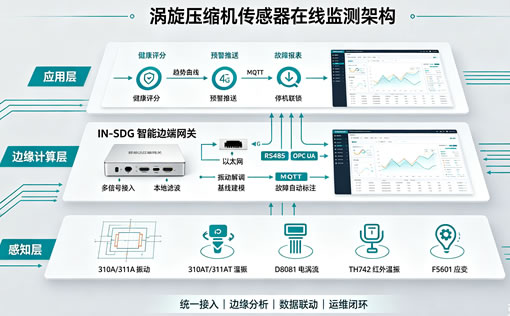
Overall four-layer architecture (from bottom-layer measurement points to upper-layer platform)
Sensing layer: SENSOR full-series dedicated sensors (vibration/temperature-vibration/eddy current/infrared temperature/strain), covering all monitoring dimensions of the compressor;
Edge computing layer: IN-SDG intelligent edge gateway, providing unified acquisition, local filtering, vibration demodulation, fault interpretation, and data standardization;
Transmission layer: 4G/Ethernet/RS485 dual links, supporting local offline caching and breakpoint resume;
Application layer: local touch screen/PLC/DCS/cloud O&M platform, enabling trend curves, warning push, fault reports, and equipment health rating.
Physical Measurement Point Layout for Monitoring (Ready for Direct On-Site Construction)
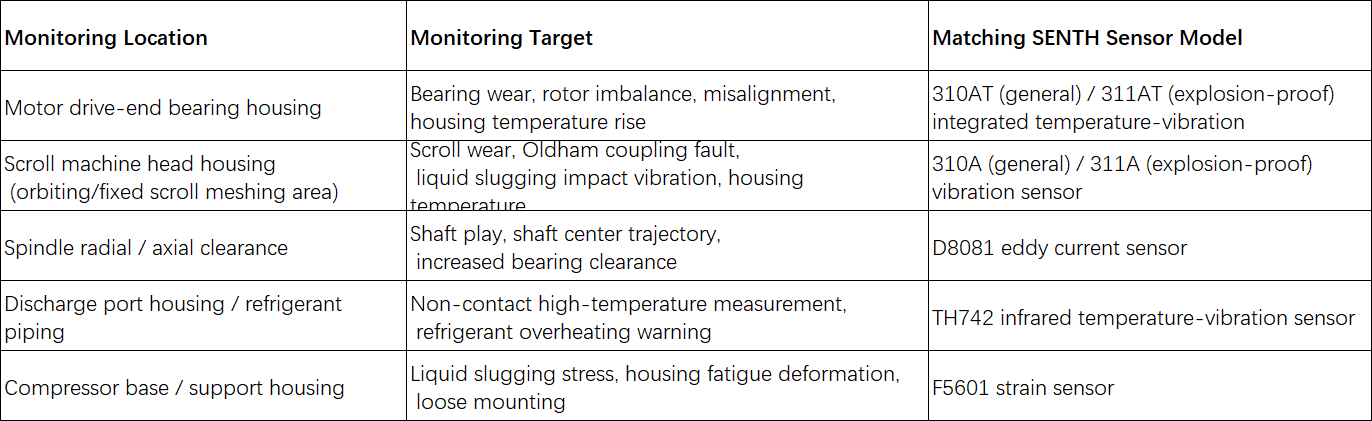
IV. Detailed Selection, Principles, and Application Value of SENSOR Technology's Full-Series Sensors (Technical Depth + Easy to Understand and Implement)
1. Online Vibration Sensor 310A (Standard Model for General Non-Explosion-Proof Areas)
Core Principle
Ring shear piezoelectric ceramic structure; the piezoelectric effect converts vibration acceleration into a standard IEPE charge signal, with a wide frequency range of 0.1–10 kHz, simultaneously capturing low-frequency rotor imbalance, high-frequency bearing impacts, and scroll meshing pulse signals.
Key Technical Parameters
• Range ±10 g/±80 g optional, sensitivity 500 mV/g;
• 316L stainless steel laser fully sealed, IP68 protection, -55~125°C wide temperature range;
• EMI electromagnetic shielding, resistant to strong electromagnetic interference from frequency converters (suitable for variable-frequency scroll machines);
• Stud rigid mounting ensures vibration signal transmission without attenuation.
Application Value in Scroll Compressors
• The machine head measurement point collects high-frequency stress waves and identifies Oldham coupling wear and scroll tooth surface collision through envelope demodulation;
• Distinguishes power-frequency low-frequency vibration from bearing fault high-frequency impacts, solving false alarms caused by speed fluctuations of variable-frequency units;
• Long-term online continuous acquisition automatically establishes a unit vibration baseline, with a 30% deviation warning and a 50% shutdown alarm.
2. Intrinsically Safe Explosion-Proof Vibration Sensor 311A (Dedicated for Chemical / Refrigerant Explosion-Proof Machine Rooms)
Core Advantages vs. 310A
Holds intrinsically safe explosion-proof certification Ex ia IIC T6, meeting explosion-proof specifications for refrigerant, oil-gas, and volatile flammable gas workshops; the circuit is intrinsically safe with current and energy limiting, with no risk of ignition by electric sparks.
Applicable Scenarios
Refrigerant refrigeration scroll units, chemical process vacuum scroll pumps, and enclosed explosion-proof air source workshops, replacing handheld inspection and enabling 24h uninterrupted explosion-proof online monitoring.
3. Integrated Temperature-Vibration Sensor 310AT (General) / Intrinsically Safe Explosion-Proof 311AT (Explosion-Proof)
Integrated Design (Solving the Pain Point of Fragmented Temperature-Vibration Data)
A single sensor synchronously outputs vibration acceleration + built-in platinum resistance temperature signal, eliminating the need to install separate vibration and temperature probes, reducing wiring, drilling, and installation points.
Monitoring Value
1. The motor bearing housing synchronously collects vibration + bearing housing temperature, accurately distinguishing two types of faults:
• Vibration rises and temperature rises synchronously: lubrication failure, bearing dry grinding;
• Vibration abnormal but temperature unchanged: rotor imbalance, mechanical looseness;
2. The 311AT explosion-proof model also has intrinsic safety certification, providing one-stop integrated temperature-vibration acquisition in explosion-proof scenarios.
4. Eddy Current Sensor D8081 (Non-Contact Spindle Clearance Monitoring)
Measurement Principle
Based on the eddy current effect, the probe has no physical contact with the metal spindle; a high-frequency magnetic field induces eddy currents on the spindle surface, and clearance changes are converted into linear voltage signals, with a resolution of 0.5 μm, capturing micro-level play.
Scroll Machine-Specific Functions
• Real-time monitoring of spindle radial runout and axial play to determine increased bearing clearance and spindle deformation;
• Plots the shaft center trajectory, providing early warning of eccentric interference between orbiting and fixed scrolls to avoid tooth tip scraping and seizing;
• Non-contact and wear-free, suitable for long-term continuous monitoring of high-speed variable-frequency spindles, which contact sensors cannot achieve.
5. Infrared Temperature-Vibration Sensor TH742 (Non-Contact High-Temperature Area Monitoring)
Dual Acquisition Capability
Infrared non-contact temperature measurement (no need to attach to the equipment surface) + built-in vibration acquisition, targeting high-temperature discharge piping and narrow areas where probes cannot be drilled and installed.
Applicable Scenarios
Compressor discharge chambers and high-temperature refrigerant piping, avoiding high-temperature aging of contact sensors, with no drilling modification and simple construction.
6. Strain Sensor F5601 (Housing Stress and Liquid Slugging Deformation Monitoring)
Principle
Strain gauges are bonded to the housing surface. When the equipment undergoes micro deformation due to liquid slugging or high-pressure impact, the strain resistance changes synchronously, outputting quantitative stress data.
Pain Point Solved
Frequent liquid slugging in scroll compressors causes housing fatigue cracks. F5601 collects periodic stress amplitudes in real time, evaluates housing structural life through long-term trend analysis, and provides early warning of cracking risk.
7. Intelligent Edge Gateway IN-SDG (Core of the Entire Plan, Simplifying the Vibration Analysis Threshold)
Core Positioning: Make Complex Vibration Waveforms "Accessible and Automated," Solving the Pain Point of O&M Staff Not Understanding Spectra
1. Unified Multi-Signal Access
Compatible with IEPE vibration, 4–20 mA temperature-vibration, eddy current voltage, strain bridge, and infrared temperature sensors; a single gateway integrates all measurement points, eliminating the need for multiple collectors.
2. Edge Local Intelligent Algorithms (Core Technical Highlight)
• Built-in scroll compressor-specific filtering algorithms: automatically filter out variable-frequency low-frequency interference and extract bearing and scroll fault characteristic frequencies;
• Real-time envelope demodulation, spectrum analysis, and time-domain impact identification, directly outputting fault conclusions locally without requiring back-end professionals to interpret waveforms;
• Automatically establishes a speed-vibration baseline model and performs load normalization calculations, greatly reducing the false alarm rate of variable-frequency units.
3. Visualized Simplified Output (Users Understand at a Glance)
The gateway's local HMI screen directly displays:
• Equipment health score (0–100, green normal / yellow warning / red alarm);
• Textual fault prompts: "Bearing rolling element pitting risk 7 days," "Oldham coupling clearance increased," "Liquid slugging stress exceeding limit";
• Integrated display of vibration trend curves, temperature curves, shaft play values, and stress curves, with no need to interpret raw waveforms.
4. System Integration Capability
Supports Modbus TCP/RTU, MQTT, and OPC UA, connecting to PLC, DCS, and industrial cloud platforms; locally caches 1 year of historical data, with no loss during network outages and automatic resume upon network recovery; supports SMS and audible/visual alarm linkage with shutdown interlock.
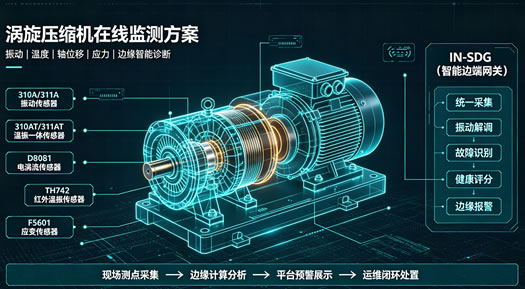
V. Complete and Executable Implementation Process of the Entire Plan (Clear Implementation Steps)
Step 1: On-Site Measurement Point Positioning and Drilling Installation (Complete a Single Unit in 1 Day)
1. Machine M6 threaded holes on the motor bearing housing and scroll machine head plane, and rigidly fix 310A/311A/310AT/311AT;
2. Reserve a mounting position at the spindle end to fix the D8081 eddy current probe and calibrate the clearance zero point;
3. Fix the TH742 infrared temperature-vibration probe on the outside of the discharge pipe, aimed at the pipe wall for temperature measurement;
4. Bond the F5601 strain gauge to the compressor base housing and apply waterproof sealing.
Step 2: Wiring and Explosion-Proof Isolation (Separate Intrinsic Safety Isolation Barrier for Explosion-Proof Areas)
1. Shielded cables in general areas are connected uniformly to the IN-SDG gateway;
2. Sensor cables in explosion-proof machine rooms are equipped with intrinsic safety isolation modules to meet explosion-proof wiring specifications.
Step 3: IN-SDG Gateway Parameter Configuration (Standardized Template, 10-Minute Commissioning)
1. Enter the compressor rated speed, power, scroll tooth count, and bearing model; the gateway automatically generates a fault characteristic frequency library;
2. Set four-level warning thresholds for vibration, temperature, shaft displacement, and stress;
3. Configure the transmission protocol and alarm push methods (local audible/visual + mobile SMS / platform messages).
Step 4: Baseline Acquisition and System Trial Operation (24h Calibration)
The unit operates at full load for 24 hours, and IN-SDG automatically collects vibration and temperature baselines under different speeds and loads, generating an exclusive judgment model to avoid false alarms under variable-frequency conditions.
Step 5: O&M Platform Integration and Personnel Training
Gateway data is uploaded to the local touch screen / cloud platform. On-site O&M personnel are trained to understand only the health score + textual fault prompts, without needing to master professional vibration spectrum knowledge.
VI. Core Benefits of the Plan (Closed-Loop Resolution of Earlier Pain Points)
1. Predict faults and eliminate unplanned downtime: provide 7–14 days early warning of bearing, scroll, and Oldham coupling wear, shifting from reactive repair to predictive maintenance, with downtime losses reduced by 90%;
2. Multi-physics fusion diagnosis for precise fault localization: four-dimensional data linkage of vibration + temperature + shaft displacement + stress distinguishes lubrication, mechanical, fluid, and structural faults;
3. Compliant implementation in explosion-proof scenarios: 311A/311AT intrinsically safe explosion-proof sensors meet the safety specifications of chemical and refrigerant machine rooms, filling the gap in explosion-proof online monitoring;
4. Lower the O&M technical threshold: IN-SDG edge intelligence automatically parses vibration waveforms and outputs accessible textual fault conclusions that ordinary operators can understand;
5. Reduce hardware and construction costs: integrated temperature-vibration sensors halve the number of installation points, and a single IN-SDG gateway uniformly collects all sensors, eliminating multiple acquisition and conditioning devices;
6. Extend the full equipment life cycle: real-time monitoring of liquid slugging stress and shaft eccentricity enables timely working condition adjustments, reducing scroll and bearing wear rates and extending overhaul intervals.
VII. Plan Summary
This scroll compressor monitoring plan adopts SENTH Technology's full-category dedicated sensors + IN-SDG intelligent edge gateway to form an integrated closed-loop monitoring system, covering five core monitoring dimensions: mechanical vibration, bearing temperature, spindle clearance, high-temperature discharge, and housing stress. It distinguishes between two hardware selection configurations for general working conditions and explosion-proof working conditions. The technical logic is complete, construction steps are standardized, and data analysis is lightweight. It not only meets the technical depth required for precision fault diagnosis of industrial equipment, but also lowers the usage threshold for on-site O&M personnel, perfectly solving all current industry pain points of scroll compressors, including lagging manual inspection, difficult fault prediction, missing explosion-proof monitoring, and obscure vibration data.
