

Dual-Sensor Fusion: Accelerometer-Vibration Sensors Open a New Paradigm for Device Perception
Traditional single accelerometer-based vibration monitoring solutions often suffer from either missing low-frequency static information or insufficient capture of high-frequency impacts. Piezoelectric IEPE and capacitive MEMS triaxial accelerometers specialize in high-frequency dynamic sensing and static/low-frequency sensing, respectively. Empowered by AI, these two sensor types form a heterogeneous high/low-frequency sensing combination that fuses high-frequency impact vibration, static offset, and low-frequency slowly-varying signals, breaking through the capability boundaries of a single sensor. In scenarios such as industrial predictive maintenance, aircraft testing, road testing, and structural health monitoring, this combination builds a complete "static attitude + dynamic vibration" perception system, bringing new product and application opportunities to the vibration monitoring industry.
I. Industry Pain Points: Capability Gaps of Single Accelerometers
Accelerometer-based vibration monitoring has become a core means of equipment fault diagnosis and structural health assessment. However, whether piezoelectric IEPE sensors or conventional MEMS sensors, standalone use presents notable limitations.
Piezoelectric IEPE solution: Excellent high-frequency dynamic performance, but unable to measure static signals. It excels at capturing mid-to-high-frequency vibration and impact signals, but due to principle constraints, cannot output 0 Hz static signals. Equipment base tilt, long-term static offset, and extremely low-frequency slow drift cannot be acquired. When equipment simultaneously exhibits structural deformation and high-speed vibration, the acquired information dimensions are incomplete.
MEMS static acceleration solution: Capable of DC static measurement, but with an upper limit on high-frequency bandwidth. It can measure static gravity, tilt angle, and extremely low-frequency slowly-varying vibration, with good temperature stability. However, its high-frequency capability falls short of high-performance piezoelectric sensors, and high-frequency impact signals from bearing spalling and gear meshing are easily missed. Standalone fault diagnosis readily loses key fault features.
In real-world operating conditions, a large number of equipment faults are composite phenomena: wind turbine main shafts, aircraft structures, and bridge steel structures all exhibit both static deformation and attitude offset, accompanied by high-frequency vibration impacts from high-speed rotation. Monitoring vibration alone cannot detect slow structural deformation; acquiring only static tilt cannot identify early damage to transmission components. Traditional solutions can only choose one or the other, resulting in missed fault detection and incomplete features available to AI models, directly constraining improvements in intelligent diagnostic accuracy.
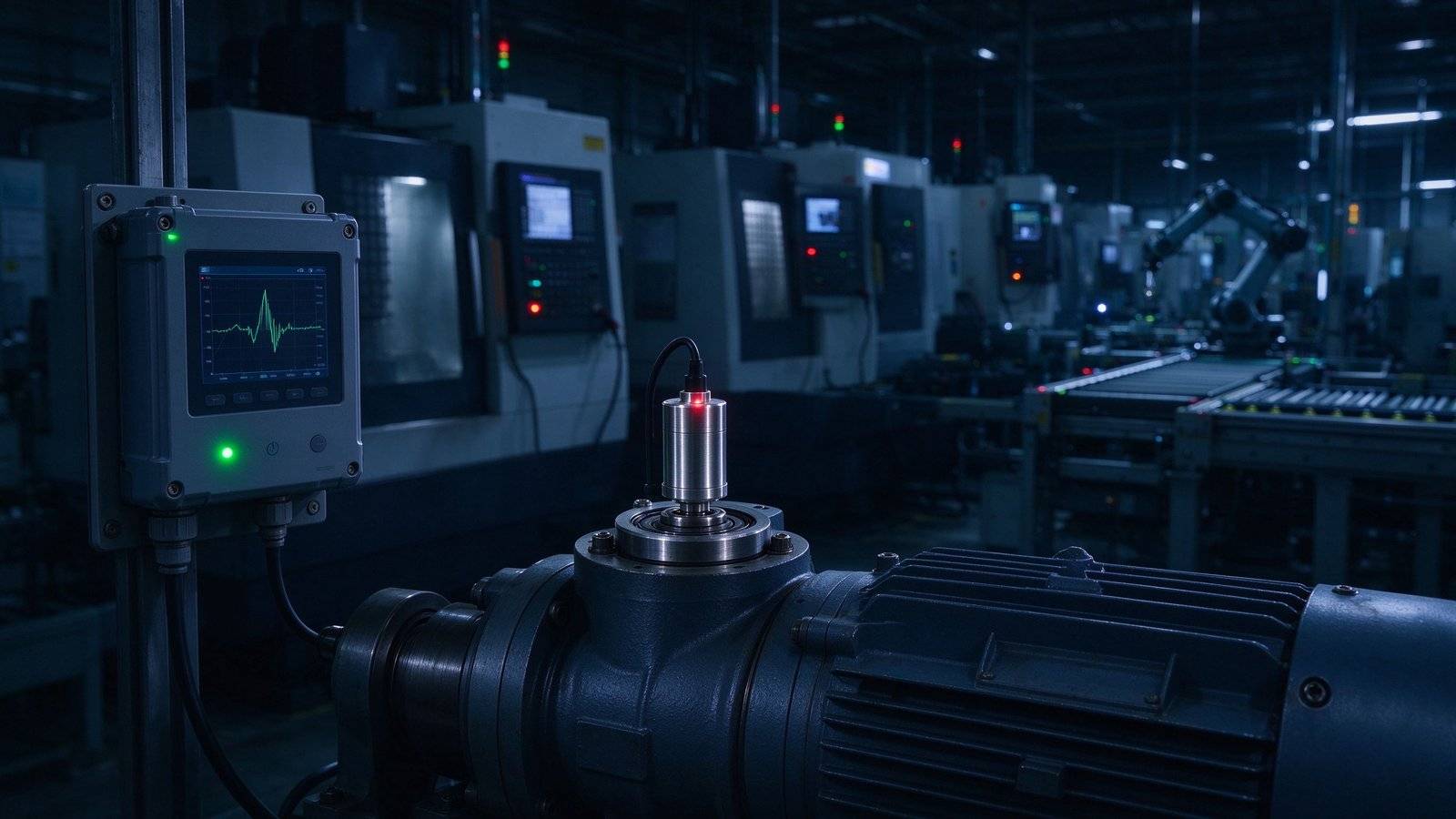
II. AI Empowerment: Technical Path for Heterogeneous Dual-Sensor Fusion
AI and TinyML technologies make the data fusion of two sensors with different principles truly valuable—no longer merely a simple superposition of two data sets, but rather AI algorithms performing feature alignment, information completion, and joint fault assessment.
1. Synchronous Multi-Source Signal Acquisition and AI Feature Decoupling
Piezoelectric sensors output high-frequency vibration waveforms, capturing bearing impacts, gear meshing, and component resonance; MEMS sensors output static/low-frequency signals, recording equipment base settlement, structural tilt, and low-frequency drift. After the acquisition system performs timestamp alignment, the AI model decouples the features of the two signal sets, separating "low-frequency trends caused by static structural deformation" from "high-frequency impacts caused by mechanical faults," eliminating the interference of operating condition drift on vibration interpretation and solving the industry pain point where a single sensor easily misjudges deformation as a vibration fault.
2. Joint Feature Library Construction to Improve Fault Identification Accuracy
AI fault models trained on a single sensor have limited feature dimensions. By fusing high-frequency spectral features with static and low-frequency trend features, a multi-dimensional fault sample library is built. Taking wind turbine gearbox faults as an example: high-frequency signals capture gear and bearing impact damage, while low-frequency static signals capture main shaft base tilt and frame settlement. AI learns both types of features simultaneously, identifying both rotating component damage and structural degradation, effectively reducing false alarms and missed detections.
3. Hierarchical Inference Architecture Balancing Calibration and Field Deployment
a. Cloud/PC-side AI for model training and calibration: During the testing phase, high-frequency vibration ground truth and attitude baselines are synchronously acquired to produce high-quality annotated datasets for training fault identification and remaining useful life prediction models.
b. Edge-side TinyML inference deployment: Lightweight models are deployed on-site. Models trained on high-precision sensor data are adapted to lower-cost MEMS sensing nodes through transfer learning, balancing monitoring accuracy and large-scale deployment cost.
4. Dynamic Baseline Self-Calibration
Long-term equipment operation leads to base deformation and temperature drift. Leveraging the continuous static offset output from MEMS, AI dynamically corrects the vibration signal baseline, moving away from the traditional practice of manually setting fixed thresholds and adapting to complex and variable actual equipment operating conditions.
III. Key Deployment Scenarios for Dual-Sensor Combinations
Scenario 1: High-End Equipment and Aircraft Testing
For aircraft component structural verification, high-frequency impact vibration and structural attitude deformation are synchronously acquired. AI distinguishes "signal fluctuations caused by attitude changes" from "vibration anomalies caused by component damage," supporting structural reliability verification and fault reproduction analysis.
Scenario 2: Civil Engineering and Large-Scale Infrastructure Structural Health Monitoring
For bridge and large steel structure monitoring, on one hand, pier settlement, structural tilt, and extremely low-frequency modes are monitored; on the other hand, high-frequency vibration impacts under wind loads and vehicle traffic excitation are acquired. AI comprehensively analyzes deformation trends and vibration spectra to identify structural cracking and stiffness degradation, achieving full-dimensional safety assessment from static deformation to dynamic vibration.
Scenario 3: Rail Transit and Road Testing
In rail vehicle and road surface testing scenarios, vehicle body attitude and low-frequency bumps are recorded while wheel-rail impacts and bogie high-frequency vibration are captured. AI distinguishes road condition disturbances from early component faults, balancing vehicle comfort assessment and component predictive maintenance.
Scenario 4: Wind Power Renewable Energy Equipment Condition Monitoring
For wind turbine nacelle and main shaft monitoring, frame tilt, base settlement, and gearbox/main shaft high-frequency vibration impacts are synchronously monitored. AI fuses both types of features to simultaneously investigate foundation structural hazards and transmission component faults, reducing high-altitude maintenance operations.
Scenario 5: Complete R&D-to-Mass-Production Chain
In the R&D phase, high-precision sensors are relied upon for ground truth acquisition and AI model training; in the mass production phase, MEMS-type sensing nodes are deployed on a large scale, migrating mature laboratory models to engineering sites, balancing R&D precision and mass-production cost.
IV. Industry Development Opportunities Brought by Dual-Sensor Fusion in the AI Era
Opportunity 1: Upgrading from Hardware Components to "Heterogeneous Sensor Combination + AI Model" Solutions
The industry is moving beyond the model of simply selling sensor hardware. By offering complete "high-frequency piezoelectric + MEMS static/low-frequency" sensing combinations with accompanying AI fusion algorithms that directly output fault classification, structural assessment, and life prediction results, product added value is enhanced, and companies transform from component suppliers into condition perception solution providers.
Opportunity 2: Differentiated Competition for Domestic Sensors, Completing Composite Monitoring Capabilities
Most overseas solutions favor either single high-frequency or single low-frequency monitoring. Domestic companies can leverage mature triaxial accelerometer products to build high/low-frequency heterogeneous fusion solutions, combined with AI models trained on local industrial and infrastructure scenario data, pursuing a differentiated domestic substitution path and filling the domestic gap in composite condition monitoring products.
Opportunity 3: Unlocking Incremental Markets and Lowering the Barrier to Composite Monitoring Deployment
In the past, high-end testing and structural monitoring required building two independent test systems, with high costs and unsynchronized data. Integrated dual-sensor + AI fusion solutions simplify system setup, opening incremental markets in aircraft R&D, infrastructure inspection, and rail transit testing.
Opportunity 4: Transfer Learning Lowers the Barrier to Large-Scale Deployment
AI models are trained using fault samples acquired by high-precision sensors, then adapted to MEMS nodes through transfer learning, solving the pain point of insufficient on-site MEMS fault samples and reducing data acquisition costs for large-scale deployment.
V. Existing Challenges and Future Development Trends
Existing Challenges
• Heterogeneous data synchronization challenges: Piezoelectric and MEMS sensors differ in interfaces and sampling rates. Inadequate time synchronization and amplitude calibration directly weaken AI fusion effectiveness.
• Contradiction between data volume and computing power: Dual-channel synchronous sampling generates larger data volumes, requiring edge-side model compression and sampling strategy optimization.
• High degree of scenario customization: Fault characteristics vary significantly across industries and equipment, requiring targeted AI model tuning; generic models yield limited results.
Future Development Trends
• Heterogeneous sensing integration: Piezoelectric and MEMS sensing units integrated into modular packages with unified interfaces, reducing customer system setup complexity.
• Proliferation of AI-native sensor modules: Modules with built-in TinyML lightweight inference units perform dual-channel data fusion locally, outputting only alarms and fault levels without uploading all raw data.
• Gradual improvement of industry datasets and standards: Leveraging domestic sensor accumulation of vibration-deformation industry datasets to promote standardization of algorithms and evaluation criteria.
VI. Conclusion
The change AI brings to the accelerometer industry is not simply adding algorithms to devices, but reshaping the application value of sensing combinations. Piezoelectric IEPE excels at capturing high-frequency dynamic impacts, while MEMS sensors excel at acquiring static offset and extremely low-frequency signals—their capabilities are naturally complementary.
Empowered by AI fusion algorithms, the "piezoelectric high-frequency + MEMS static/low-frequency" dual-sensor architecture connects the complete information chain of static deformation, low-frequency trends, and high-frequency vibration impacts, presenting broad opportunities in high-end testing, infrastructure, rail transit, and renewable energy equipment. In future industry competition, the focus will no longer be solely on single hardware metrics such as range and noise; heterogeneous sensing combination capability, multi-source AI fusion capability, and industry-oriented complete solution capability will become core competitiveness for enterprises.
