

I. Industry Trends Under the 15th Five-Year Plan and the Necessity of Upgrading
(1) The 15th Five-Year Plan's Guidance on Intelligent Upgrading
The Outline of the 15th Five-Year Plan explicitly calls for comprehensively advancing digital-intelligent technology empowerment and promoting "intelligent transformation, digital upgrading, and network connectivity" in manufacturing. The goal is for 80% of above-designated-size manufacturing enterprises to achieve digital transformation by 2030. The core is to drive production with data, replace manual experience with intelligence, and break down collaboration barriers through networking. The Plan emphasizes deep AI-manufacturing integration, supports traditional enterprises in implementing integrated hardware-software upgrades around typical scenarios, advances intelligent upgrading of standalone equipment, production lines, and workshops, and strengthens requirements for safety, green development, and efficiency.
(2) Necessity of Intelligent Upgrading for Flour Mill Equipment
1. Policy compliance imperative: As a foundational livelihood industry, grain processing is a key area for intelligent transformation of food manufacturing under the 15th Five-Year Plan. Intelligent upgrading addresses three mandatory policy requirements—workplace safety, quality traceability, and energy conservation—and mitigates compliance risks.
2. Industry pain points: Traditional flour mills face five core challenges: high equipment failure rates, maintenance dependent on manual labor, high dust explosion risk, high energy consumption, and poor quality consistency. Manual inspection miss rates exceed 30%, and unplanned downtime occurs frequently. Electrical equipment in dusty environments is prone to dust accumulation and short circuits, posing significant safety hazards. Energy accounts for 20%–30% of production costs, leaving substantial room for savings.
3. Market competitiveness: Consumer demand continues to rise for flour quality consistency, food safety traceability, and customized production. Intelligent upgrading enables precise control of production parameters, full-process traceability, and flexible manufacturing, enhancing product added value and market competitiveness.
4. Core demand for cost reduction and efficiency gains: Intelligent transformation can reduce labor costs by 30%–50%, equipment failure rates by over 40%, and energy consumption by 15%–25%, while improving flour yield and product qualification rates, significantly boosting economic returns.
II. AI Computing Power Support and Maturity of Upgrade Timing
(1) Robust AI Computing Power Support
1. Sufficient computing scale: As of 2025, China has built 42 10,000-card intelligent computing clusters, with intelligent computing power exceeding 1,590 EFLOPS, ranking among the world's leaders. Edge computing is rapidly expanding downward, with industrial edge gateway computing power reaching 10 TOPS, sufficient to meet low-latency, high-reliability AI inference needs for equipment condition monitoring, fault warning, and process optimization in flour mills.
2. Sharp decline in computing costs: With large-scale application of domestic AI chips (e.g., Huawei Ascend, Hygon), edge computing costs have dropped by over 70% compared to five years ago, making them affordable for SMEs. The three-tier computing architecture of public cloud + private cloud + edge is mature; flour mills need not build large-scale computing centers but can call on demand.
3. Algorithm models adapted to the industry: Industrial large models (e.g., flour-processing-specific models) have achieved deployment in equipment fault diagnosis, process parameter optimization, and dust concentration prediction. Models are lightweight and can be deployed on edge gateways with response times [*], adapting to the continuous production needs of flour mills.
(2) Fully Mature Timing for Intelligent Equipment Upgrading
1. Technical maturity: Core technologies such as sensors, edge computing, industrial internet, and AI algorithms have matured domestically. Specialized equipment including intrinsically safe explosion-proof dust sensors and integrated temperature-vibration sensors have been applied at scale in dust explosion hazardous environments in the grain, oil, and chemical industries, with fully validated stability and reliability.
2. Mature industrial ecosystem: During the 15th Five-Year Plan period, industrial internet platforms, intelligent equipment suppliers, and system integrators have formed a complete ecosystem. Intelligent transformation of flour mills can be delivered as integrated "hardware + software + services" solutions, with implementation periods shortened to 3–6 months and controllable risks.
3. Replicable benchmark cases: Leading flour enterprises such as Wudeli and Baiyan Grain & Oil have built smart factories/lighthouse factories. Through intelligent transformation, they have achieved 30% higher production efficiency, 35% fewer unplanned downtime incidents, and shortened food safety risk warning cycles from 72 hours to 2 hours, validating the model's feasibility and significant benefits.
4. Continuous policy incentives: Local governments provide fiscal subsidies (up to 30%), tax reductions, and low-interest loans for intelligent transformation of manufacturing, reducing transformation costs and improving investment returns.

III. Core Equipment and O&M Model Upgrading for Flour Mills
(1) Core Equipment List for Flour Mills
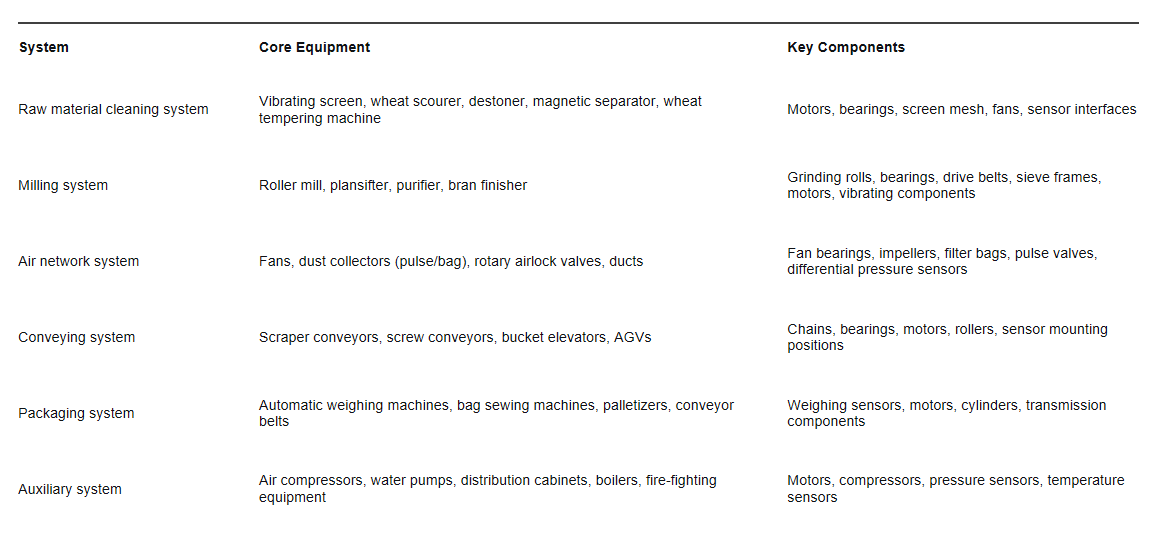
The full-process equipment of a flour mill is divided into six core systems, with key equipment as follow
(2) Equipment Requiring Priority Upgrading and Traditional O&M Models
1. Priority upgrading equipment
• Rotating equipment: Roller mills, fans, motors, conveyors, elevators (high failure rates, critical core);
• Screening/filtration equipment: Plansifters, vibrating screens, dust collectors (harsh dust environments, prone to clogging/wear);
• Power/control equipment: Air compressors, distribution cabinets, frequency converters (high energy consumption, significant electrical safety risks);
• Safety monitoring equipment: Dust concentration monitors, temperature/vibration sensors (traditional devices have low accuracy and no networking capability).
2. Traditional O&M model (before upgrading)
• Inspection method: Manual periodic inspection (2–3 times per shift) + reactive maintenance, relying on veteran workers' experience without data support;
• Monitoring means: No online monitoring or only simple instruments; key parameters such as temperature, vibration, and dust concentration cannot be collected in real time;
• Fault handling: Shutdown and troubleshooting after failure occurs; long repair times (average 4–8 hours); significant unplanned downtime losses;
• Safety management: Manual spot checks of dust concentration (1–2 times per day), prone to missed detection, high dust explosion risk; manual cleaning of equipment dust accumulation, low efficiency and high risk;
• Energy management: Monthly statistics of total energy consumption; unable to identify high-energy-consuming equipment; no direction for energy-saving optimization.
(3) Intelligent O&M Model (after upgrading)
• Inspection method: 7×24 online monitoring + AI predictive maintenance + remote O&M; manual labor shifts to auxiliary patrolling;
• Monitoring means: Full sensor coverage across all equipment; real-time collection of 10+ categories of key parameters including temperature, vibration, dust concentration, pressure, and current; data uploaded in real time to edge gateways and cloud platforms;
• Fault handling: AI algorithms analyze data in real time, providing 7–30 days advance warning; precise fault component localization; maintenance personnel arrive with spare parts; repair time shortened to 1–2 hours; unplanned downtime approaching zero;
• Safety management: Real-time online dust concentration monitoring + automatic over-limit alarms + linked dust collection equipment; intrinsically safe explosion-proof design adapts to dusty environments, eliminating explosion risks from electrical sparks; automatic monitoring of equipment dust accumulation with intelligent cleaning reminders;
• Energy management: Real-time energy monitoring by equipment + AI energy analysis; precise identification of high-energy-consuming equipment; automatic optimization of operating parameters, achieving 15%–25% energy savings;
• Collaborative management: Equipment, production, quality, and energy data integrated to achieve a "monitor–analyze–decide–execute" closed loop; central control room remotely monitors the entire workshop; operators reduced by over 50%.
IV. Senther Technology Product Solutions and Advantages
(1) Core Product Application Scenarios and Supporting Solutions
1. Intrinsically Safe Explosion-Proof Dust Sensor (Core Product)
• Models: 311AT series, 340ATM2 series (dust/gas dual-certified intrinsically safe explosion-proof);
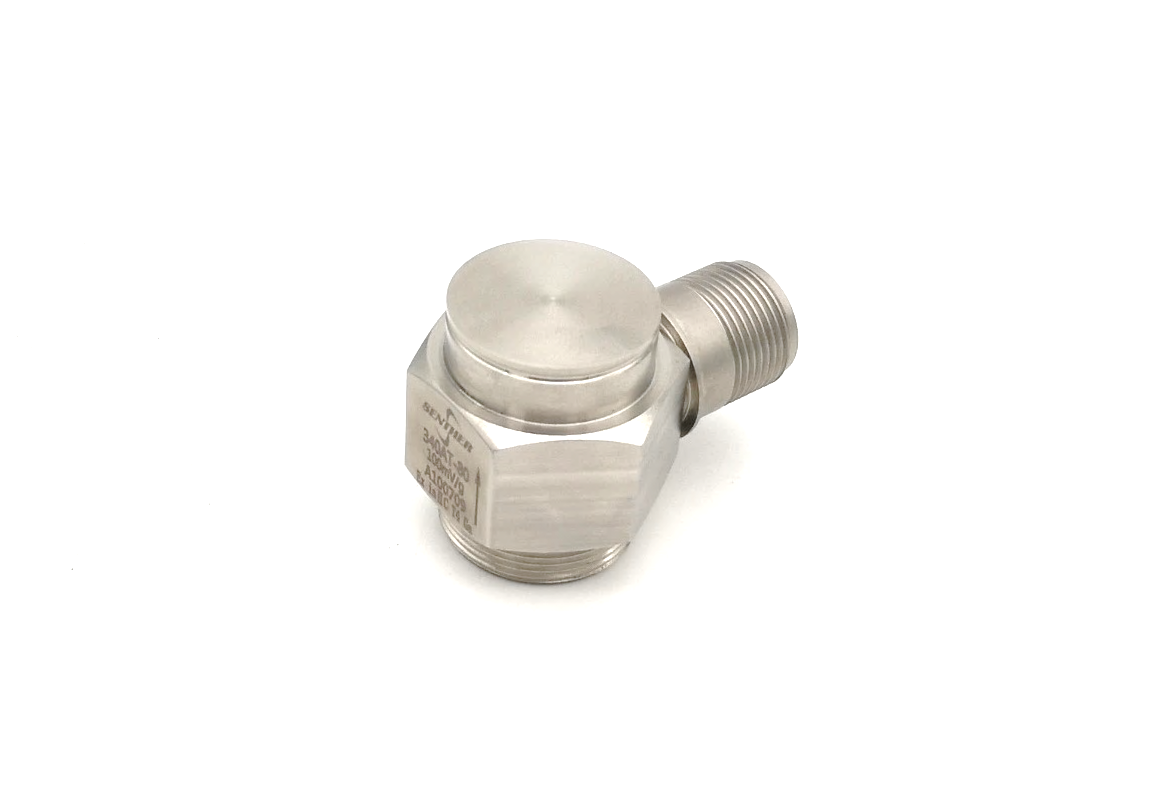
• Application scenarios: Dust collectors, roller mills, plansifters, dust ducts, and other high dust explosion hazard areas; monitoring vibration, temperature, and dust concentration;
• Supporting solution: Install 2–3 340ATM2 integrated temperature-vibration sensors per roller mill (monitoring bearing/roll condition); install 1 311AT dust + temperature-vibration composite sensor per dust collector (monitoring filter bag clogging, fan bearing temperature/vibration, and dust concentration); sensors connect directly to Senther's IN-SDG intelligent edge gateway.
2. Integrated Temperature-Vibration Sensor (General Monitoring)
• Models: 310AT series, 340AT series (industrial-grade high protection);
• Application scenarios: Motors, fans, conveyors, elevators, and other rotating equipment; monitoring bearing temperature and vibration acceleration/velocity/displacement;
• Supporting solution: Install 1 310AT-80 sensor per motor/fan (outputting dual vibration + temperature signals); install 1 340AT sensor at each head and tail pulley of conveyors; wireless/wired connection to gateway for full equipment condition monitoring.
3. Intelligent Edge Gateway (Data Hub)
• Model: IN-SDG series (industrial-grade multi-protocol edge computing gateway);
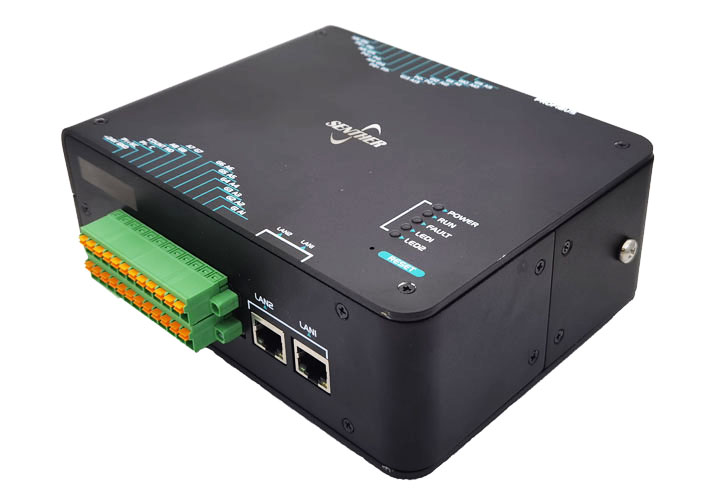
• Application scenarios: Centralized data collection from workshop equipment, edge computing, protocol conversion, data upload to cloud;
• Supporting solution: Deploy 1–2 IN-SDG gateways per workshop; compatible with Modbus, 4–20mA, LoRa, 4G and other protocols; connect all sensor data; run AI fault warning algorithms locally for real-time alerts + encrypted data upload to cloud platform; cache data locally during network outages and automatically backfill upon reconnection.
4. Wireless Sensors (for Difficult Wiring Scenarios)
• Model: WL4001 series (low-power long-range wireless acceleration sensor);
• Application scenarios: Plansifters, wheat tempering machines, ducts, and other equipment with difficult wiring and high movement/vibration;
• Supporting solution: LoRa wireless transmission with communication range up to 5 km; battery life over 2 years; no wiring required; rapid installation; data uploaded to gateway; adapts to complex working conditions.
(2) Core Product Features
1. Intrinsically Safe Explosion-Proof Dust Sensor (Core Advantage)
• Intrinsically safe explosion-proof certification: Dust/gas dual explosion-proof certification (Ex ia IIC T6 Ga/Ex ta IIIC T85°C Db), suitable for Zone 20/21 dust explosion hazardous environments in flour mills; eliminates electrical sparks; highest safety level;
• High-protection design: Stainless steel housing + laser-welded sealing; IP68 protection rating; high-temperature resistance (−40°C to 125°C); moisture resistance; dust ingress protection; adapts to high-dust, high-humidity harsh conditions in flour mills;
• Integrated temperature-vibration: Single sensor simultaneously measures vibration (acceleration/velocity) + temperature; reduces installation count and cost; precisely captures early fault indicators such as bearing wear and overheating;
• High sensitivity and wide frequency response: Frequency response range 0.5 Hz–28 kHz; captures both low-frequency (imbalance/misalignment) and high-frequency (bearing damage/gear wear) fault signals across the full frequency band; fault identification accuracy >95%;
• Long-term stability: Ring shear mode ceramic crystal sensing element; long-term stable output signal with minimal drift; calibration-free period >2 years; reduces maintenance costs.
2. Intelligent Edge Gateway
• Multi-protocol compatibility: Supports Modbus RTU/TCP, 4–20mA, 0–5V, LoRa, Zigbee, 4G/5G; seamlessly connects with Sensor sensors and third-party equipment; reduces transformation compatibility risks;
• Edge computing capability: Built-in AI inference chip; can locally run fault warning, vibration analysis, temperature over-limit judgment and other algorithms; response time [*]; no cloud dependency; warning functions continue during network outages;
• High reliability: Industrial-grade design; wide temperature range (−40°C to 70°C); interference resistance; lightning protection; dual power redundancy; supports 7×24 continuous operation; adapts to complex electromagnetic environments in workshops;
• Easy deployment and maintenance: DIN-rail mounting; plug-and-play; supports remote configuration, remote upgrades, and remote fault diagnosis; maintenance efficiency improved by 80%.
3. Common Advantages of the Full Sensor Series
• Domestic high cost-performance: 100% domestic supply chain; breaks foreign monopolies; priced over 30% lower than imported sensors with equal or superior performance;
• High shock resistance: Shock limit 2,000g–5,000g; withstands instantaneous overloads from equipment start/stop and material impact; durable and long-lasting (>5 years);
• Flexible installation: Supports threaded mounting, magnetic mounting, and adhesive mounting; adapts to different equipment surfaces; installation time in minutes per unit.
(3) Supporting Implementation Recommendations
1. Phased implementation:
• Phase I (1–2 months): Prioritize upgrading roller mills, fans, dust collectors, and other core high-risk equipment; deploy Sensor intrinsically safe explosion-proof dust sensors + edge gateways to achieve online monitoring and fault warning for key equipment;
• Phase II (2–3 months): Expand to all equipment in conveying, packaging, and auxiliary systems; deploy wireless sensors; break down equipment data silos;
• Phase III (1 month): Integrate with MES/ERP systems; build an intelligent O&M platform; achieve full-process data visualization, intelligent decision-making, and collaborative management.
2. Sensor installation key points:
• Install intrinsically safe explosion-proof dust sensors at vibration/temperature-sensitive locations such as equipment bearing housings, grinding rolls, and dust collector bodies; keep away from high-temperature heat sources and strong electromagnetic interference;
• Install wireless sensors at heights >2 m; avoid material obstruction; ensure stable wireless signals;
• Ensure reliable grounding of all sensors to prevent static electricity accumulation that could trigger dust explosions.
3. Data security and compliance:
• Encrypted transmission and encrypted storage of sensor and gateway data, in compliance with the Data Security Specifications for Grain Processing Enterprises;
• Real-time upload of dust concentration monitoring data to local emergency management department platforms to meet work safety regulatory requirements.
V. Plan Summary
This plan closely aligns with the intelligent upgrading guidance of the 15th Five-Year Plan and addresses the industry pain points of flour mills—high dust, high risk, high energy consumption, and low efficiency. Centered on AI computing power + Senther Technology's intelligent sensing equipment, it builds a full-chain intelligent O&M system covering "sensing–transmission–computing–warning–O&M." The upgrade timing is mature, technically feasible, and the benefits are significant.
(1) Core Value Summary
1. Safety upgrade: Full coverage of Sensor intrinsically safe explosion-proof dust sensors; real-time dust concentration monitoring + over-limit alarms + linked control; completely eliminates dust explosion risks; advance warning of equipment faults prevents safety accidents from equipment running with defects; work safety level improved by 100%.
2. Cost reduction and efficiency gains: Intelligent O&M replaces manual inspection; labor costs reduced by over 50%; AI predictive maintenance reduces unplanned downtime; equipment failure rates reduced by 40%; repair time shortened by 70%; precise energy monitoring and optimization achieves 15%–25% energy savings; intelligent regulation of production parameters increases flour yield by 1%–2% and product qualification rate reaches 99.98%.
3. Management upgrade: Real-time data collection and visual display across all equipment; transition from "experience-based management" to "data-driven"; remote O&M + intelligent decision-making; management efficiency improved by 80%; full-process quality traceability meets high-end market and food safety regulatory requirements; market competitiveness significantly enhanced.
4. Compliance upgrade: Complies with 15th Five-Year Plan and grain processing industry policy requirements for intelligentization, work safety, and energy conservation; mitigates compliance risks; benefits from policy subsidies; investment payback period of 3–5 years.
(2) Implementation Guarantee
As a benchmark enterprise in domestic intelligent sensing, SentherTechnology provides an integrated "sensor + gateway + algorithm + platform + service" solution. Its products are adapted to dust explosion-proof working conditions in flour mills, highly reliable, and cost-effective, and have been validated in multiple benchmark projects in the grain and oil industry, ensuring rapid project deployment, stable operation, and long-term benefits.
(3) Outlook
Intelligent upgrading of flour mill equipment is an inevitable industry trend during the 15th Five-Year Plan period. Implementation of this plan will help flour mills achieve leapfrog transformation from "traditional manufacturing" to "intelligent manufacturing," consolidate the safety bottom line, reduce operating costs, improve product quality, and enhance core competitiveness, injecting strong momentum into high-quality, sustainable development.
