


Flexible tactile sensors (FTS) are capable of sensing mechanical force signals such as strain, pressure, and shear forces, and are widely used in fields such as bionic prosthetics, health monitoring, artificial intelligence, and wearable devices. The ideal FTS needs to have both high sensitivity and high precision tactile signal detection capabilities. In practical applications, FTS is inevitably exposed to external interference environments such as mechanical shock, temperature and humidity changes. The complex interference generated by multiple stimuli can significantly affect the perception ability of FTS, thereby reducing its sensing accuracy. However, most existing FTS lack anti-interference capabilities, which can easily lead to perception errors or measurement distortions, greatly limiting their practical application scenarios. Therefore, developing FTS with simple structure, strong anti-interference ability, and high sensitivity has become an urgent need at present.
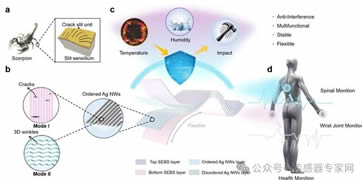
In response to the above issues, Professor Liu Jianwei's team from the University of Science and Technology of China reported a strain and pressure dual-mode FTS with excellent anti-interference capabilities using nanowire interface assembly technology combined with mechanical strategies. The relevant research results were published in Nano Letters. Wang Wenze and Li Xinlin, doctoral students at the University of Science and Technology of China, are co first authors of the paper. Professor Liu Jianwei is the corresponding author.
In nature, many organisms rely on their own microscale structures to perceive external mechanical forces. For example, scorpions detect environmental vibrations through curved crack receptors located between their tarsal bones and leg joints. Therefore, inspired by the highly sensitive crack sensor, the research team developed a high-performance, anti-interference dual-mode FTS (Figure 1). By combining nanowire interface assembly with mechanical strategy assisted assembly, large-scale ordered silver nanowire thin films were prepared. In addition, this study achieved excellent strain sensing performance (sensitivity up to 7.58 × 10⁵; minimum detection limit of 0.01%) and excellent pressure sensing performance (Figure 3) by regulating the assembly direction of the interface.
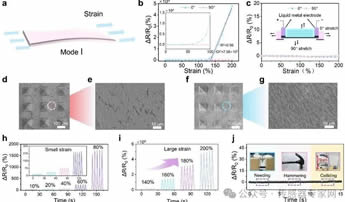
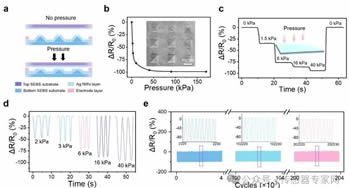
This article proposes a unique bimodal FTS inspired by biology, which achieves perception of two modalities. FTS has ultra sensitive strain sensing capability in modal analysis; In Mode 2, it has excellent and stable pressure sensing ability. In addition, both modes of FTS have excellent anti-interference performance, which can resist external mechanical impacts and changes in temperature and humidity. Finally, integrating FTS onto the surface of human skin can be used for real-time and accurate monitoring of wrist and spine movements. This work has promoted the development of flexible sensors in the fields of medical health and human monitoring.
The research was supported by the National Natural Science Foundation of China and the strategic key research project of the Chinese Academy of Sciences, as well as the micro nano research and manufacturing center of the University of Science and Technology of China, the physical and chemical science experiment center of the University of Science and Technology of China and the AI Scientist robot platform of the Chinese Academy of Sciences.
Source: Sensor Expert Network