

Urban rail vehicles carry the daily commute of entire cities, so safe operation depends on knowing the true condition of every component. As mileage and service hours accumulate, parts wear, age, fatigue, and deform — and these changes surface first as vibration. Vibration measurement has therefore moved into the mainstream of maintenance practice: plan-based inspection and overhaul now rely on it, and rolling stock manufacturers list vibration testing as part of factory quality acceptance.
From Static Inspection to Dynamic Vibration Measurement
The first requirement of any vibration measurement is a rigid connection between sensor and object, so that the sensor captures the true vibration signal. Reciprocating motion of a body about its equilibrium position is what we call mechanical vibration, or simply vibration.
Railway dynamic vibration measurement records the continuous running condition of a locomotive online, producing fuller data than conventional static inspection. Damaged locations can be pinpointed and repaired in time, which cuts equipment downtime. Compared with legacy tools such as hot-bearing or traction-device detectors, vibration monitoring resolves far more detail: it targets specific components, predicts faults before they develop, and reduces maintenance cost.
What Vibration Monitoring Measures
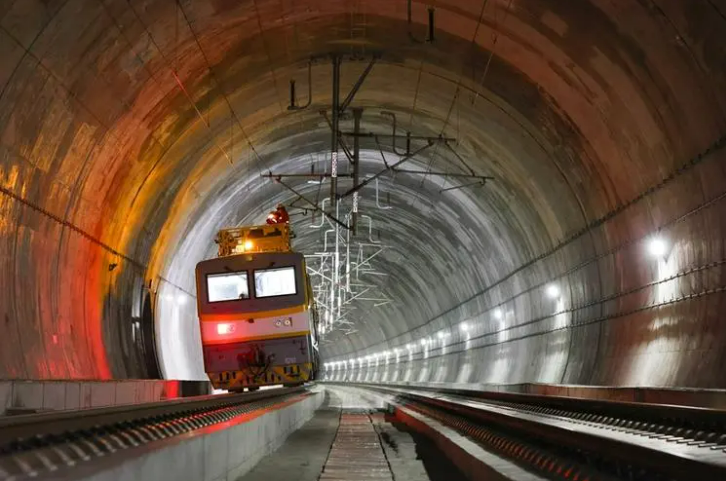
By measuring vibration frequency, amplitude, and phase, sensors evaluate both the running condition of the train and the health of the track structure. These parameters reveal component wear and aging as well as structural damage, so faults can be predicted and maintenance scheduled rather than triggered by failure. Monitoring train-induced vibration also exposes abnormal vibration in structures in time for corrective action, and it supports fatigue and durability assessment of track structures — a scientific basis for engineering design and future maintenance planning.
Application Scenarios
- Real-time monitoring. Sensors placed at tunnel walls, tunnel crowns, and other critical positions track train-induced vibration continuously and flag anomalies while they are still developing.
- Remote monitoring. Wireless sensors transmit data over the network, so maintenance teams can review conditions and analyze trends from any location.
- Construction monitoring. During metro tunnel construction, vibration monitoring confirms structural safety and prevents damage caused by construction activity.
374A Seismic Pulsation Sensor
The 374A series is built for very-low and low-frequency vibration in large buildings, infrastructure, and seismic monitoring. Its sensing mechanism outputs a low-noise, high-amplitude signal with excellent measurement resolution. Ceramic crystals serve as the sensing element — they deliver higher output efficiency than quartz, and therefore better signal quality and low-frequency response — while a built-in low-noise signal modulator raises resolution further. For best results the sensor is used together with a gain amplifier and a power/signal modulator.
The stainless steel housing is laser-welded to a military-grade connector, with an isolated shell and internal shielding, so the effects of RF, EMI, ESD, overload, and mishandling remain under control. That construction is what secures the sensor's repeatability and long-term stability.
Two versions are available by output sensitivity: 374A-0.25 and 374A-0.5. The ultra-high-sensitivity 374A-0.25 is designed for exceptionally low body noise and low-frequency response, making it suitable for seismic pulsation sensing, micro-acceleration of bridges, sway of buildings and towers, micro-deformation of dams under water load, spectral analysis of shockwave feedback in geological exploration, ocean seabed pulsation, and micro-vibration acquisition in subsea, high-speed rail, and metro tunnels.
Technical Advantages
- Wireless transmission. Removes the complexity of conventional cabling and the risk of cable aging and damage.
- Multi-parameter measurement. Temperature and other parameters are captured alongside vibration, giving a more complete assessment.
-
Threshold alarms. Once abnormal vibration is detected, maintenance personnel are notified immediately.

540C and 590C Embedded Piezoelectric Accelerometers
The 540C is a compact, high-performance accelerometer for embedded condition monitoring. It uses current piezoelectric technology to achieve a higher signal-to-noise ratio and wider frequency response than conventional sensors, while its ring-shear construction guarantees the long-term stability and low noise that industrial monitoring demands. Typical noise density is 4 µg/√Hz at 1 kHz, with an operating current of 1 mA; the sensor withstands shocks up to 5000 g and supports several mounting methods.
Powered from 3 to 5.5 Vdc, the 540C outputs a vibration voltage signal directly, without external circuitry — simple to use, and equally suited to industrial sites and battery-powered wireless devices. The package measures just 10 × 10 × 5.5 mm and is SMD-mountable, with an operating range of −40 °C to +125 °C. The 590C extends the same platform to three-axis measurement in a single embedded chip for space-constrained monitoring points.
For urban rail transit, the practical value is straightforward: continuous monitoring plus data analysis turns maintenance from reactive repair into planned intervention, raising both the safety and reliability of the network.
